
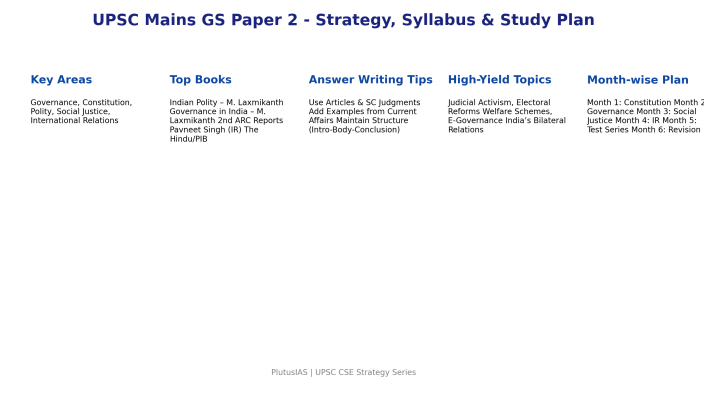
How to Prepare for UPSC GS Paper 2 (Mains): Polity, Governance, IR Strategy 2026
Last Updated: May 6, 2026
Updated for UPSC CSE 2026: This UPSC GS Paper 2 guide is fully refreshed for the 2026 examination cycle, with current trends, latest data, and topper-validated strategy. Whether you are a first-time aspirant or coming back for another attempt, the framework below gives you a structured, examination-ready approach.
Indian Constitution
Historical underpinnings, evolution, features, amendments, significant provisions, basic structure.
Functions of Government
Parliament & State legislatures, structure, functioning, conduct of business, powers & privileges.
Governance & Social Justice
Welfare schemes for vulnerable sections, performance, mechanisms, laws, institutions.
International Relations
India’s foreign policy, neighbourhood, bilateral relations with major powers, multilateral forums, diaspora.
Statutory & Regulatory Bodies
Constitutional posts, statutory regulatory and quasi-judicial bodies, Election Commission, CAG, NHRC, etc.
Answer-Writing Framework
Every Mains answer should follow a clear structure: (1) Introduction with definition or recent data, (2) Body with 3-5 sub-headings, (3) Concrete examples, schemes, court verdicts, committee reports, (4) A diagram or flowchart where possible, (5) Conclusion linking to SDG, Vision-2047, or recent policy. Stick strictly to the word limit.
Common Mistakes to Avoid
- Reading too many sources, pick fewer, finish them.
- Skipping answer-writing till “syllabus is complete”, start writing from Day 1.
- Ignoring revision, anything not revised three times is effectively forgotten.
- Treating current affairs as separate from static, always link news to syllabus heads.
- Not taking evaluated tests, feedback is the highest-leverage input.
Frequently Asked Questions
Q1. How many hours per day are needed for serious UPSC preparation?
8-10 hours of focused study during the foundational phase; 6-7 hours during the revision and test-taking phase. Quality matters more than raw hours.
Q2. Are coaching classes necessary?
Not strictly necessary, but a structured programme with personalised feedback significantly accelerates progress for most candidates. Self-study works only with strong discipline and access to high-quality test evaluation.
Q3. How should I integrate current affairs?
Daily newspaper reading (The Hindu / Indian Express) plus one monthly compilation. Always map every news item to a specific syllabus head.
Q4. How many revisions before the actual exam?
A minimum of three revisions of every static topic, and at least four revisions of high-yield current affairs in the final 60 days.
Q5. What is the single biggest differentiator for top ranks?
Consistent, evaluated answer writing. Topper interviews from CSE 2024 and 2025 universally cite this as the inflection point.
Recommended Coaching Partners
- Plutus IAS, known for individual mentorship and structural feedback on Mains answer writing.
- The Hindu Zone, daily newspaper analysis and curated Mains compilations for serious UPSC aspirants.
Final Word
UPSC preparation rewards discipline, structure, and feedback over raw hours. Build your daily and weekly cadence, evaluate yourself regularly, and trust the process. The 2026 cycle will reward the candidate who shows up consistent, current, and confident.
For more guides and topper interviews, explore the IAS Preparation section on this blog.
« How to Prepare for UPSC GS Paper 1 (Mains): Complete 2026 Strategy O2 IAS Academy HAS Coaching in Chandigarh reviews »
Tell us Your Queries, Suggestions and Feedback