
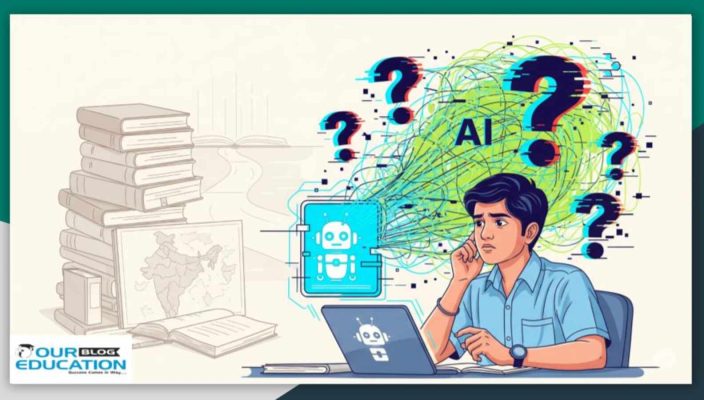
UPSC Exam Preparation: Risks of Relying on Unverified AI Content for Preparation
Last Updated: Aug 4, 2025
UPSC Exam Preparation: With digital transformation, the field of education is undergoing rapid change, with AI playing an increasingly prominent role. AI-generated content, once restricted to study materials, is now extended to evaluative materials of mock tests and answer writing for candidates. Heavy reliance on generic and unverified AI content could lead an aspirant astray.
Risks of Relying on Unverified AI Content for UPSC Exam Preparation
The UPSC is a dynamic, analytic, and ever-evolving pattern. So, an aspirant who has his success hinged on apprised, working-surface-level solutions stands little chance of making it. A few more hidden dangers posed by unverified AI content insinuate why Plutus IAS emphasises verified, expert-curated material on its platform.
1. Lack of Contextual Understanding
Many AI-based answering tools do not grasp the contextual depth needed for many questions in the UPSC standard, especially those whose training data are not oriented towards the UPSC examination. They may churn out an answer which is at least factually correct, but it does not mean it fulfils the demands of either a UPSC Mains or UPSC Essay paper. UPSC Exam Preparation does not look for facts only, but interpretation, interlinking of subjects, and value addition – things that AI may not effectively provide.
2. Out-of-date or Incorrect Information
AI models trained on data that is not very frequently updated can give outdated facts, case laws, or policy data. For a UPSC exam, which requires knowledge that is very much up-to-date, especially in current affairs, this can become a major deterrent. Aspirants relying entirely on AI without verifying the data can end up writing irrelevant or downright wrong answers.
The content at Plutus IAS is regularly updated by faculty and mentors who carry loads of experience and keep the content in accordance with the UPSC syllabus and current trends.
3. Over-Generalisation and Repetition
Many AI-generated answers lack uniqueness. They tend to overuse generic phrases or common arguments without giving considerate or nuanced perspectives. In UPSC Exam Preparation, answer writing requires genuineness, clarity, and depth to stand a chance. Over-reliance on generic AI material can yield shallow, generic answers.
Plutus IAS works at developing your analytical skills through regular answer writing, feedback, and mentorship so that you might slowly develop your personality-based writing style.
4. Less Pedagogical Structuring
With that, the transformation of theory or syllabus is made into an art of structuring content in relation to the subject of UPSC preparation. Generic AI hardly has a pedagogic approach-from basic to advanced, integration of Prelims and Mains, or a pure topic-wise approach.
The Plutus IAS illustrates preparing a course on a tier basis to include both basic and advanced studies so as to lessen cognitive load and enhance memory retention.
5. Absence of Human Mentorship
One of the biggest deterrents AI-generated content can have is the absence of human judgment. Human mentorship benefits UPSC aspirants by providing a perspective on assessing an individual’s strengths and weaknesses, mindset, and pace of learning. AI cannot do that; instead, Plutus IAS’s seasoned mentor offers input both motivational and strategic.
Preparing for the UPSC Exam is long and often taxing. Having a mentor to provide guidance and reassurance, even in the slightest, makes a world of difference in an aspirant’s performance.
6. Risk of Misinformation and Plagiarism
Misinformation bubbles to the surface when content is pulled by some of the AI tools from contrary or doubtful sources. Content copied without actually rephrasing or understanding it constitutes a kind of unintentional plagiarism that evaluators at the UPSC will easily pick up on.
At Plutus IAS, candidates are taught how to build original insight, back it up with verified facts, and then put it in their own wording, which is one of the major scoring factors at the Mains stage.
Conclusion
So while AI can be helpful from a convenience and at-best preliminary guidance stand, reliance without any form of validation is faced with a very tangible edge for serious exam preparation in UPSC. In the UPSC, a good blend of modern and up-to-date content coupled with human mentoring, set study plans, and hard drills is required, all of which a good institute like Plutus IAS can offer. Candidates should keep in mind that success in UPSC is about critical thinking, originality, and relevance-qualities that can best be fostered through guided preparation rather than by generic AI-generated content. Do not forget to verify, personalise, but most importantly, trust expert-driven coaching, which leaves you ahead in your UPSC race.
Follow the Blogoureducation Channel on WhatsApp
To get the latest updates, connect with the Education YouTube channel
Related article
- Plutus IAS Coaching Institute in Delhi Review
- Vajiram and Ravi IAS delhi reviews
- best ias coaching in Karol Bagh
- Best Online UPSC Preparation
- UPSC Coaching in India
- best ias coaching in delhi
- best ias coaching in Ghaziabad
- Drishti IAS Classroom Coaching Delhi Reviews


Discover more from Our Education | Best Coaching Institutes Colleges Rank
Subscribe to get the latest posts sent to your email.
« UPSC CSE Study Plan : Personalised Study Plans vs. Generic Schedules How to effectively revise the vast UPSC syllabus before Mains? »
Tell us Your Queries, Suggestions and Feedback