
UGC-NET June 2026 provisional answer key delay
Last Updated: Aug 5, 2026
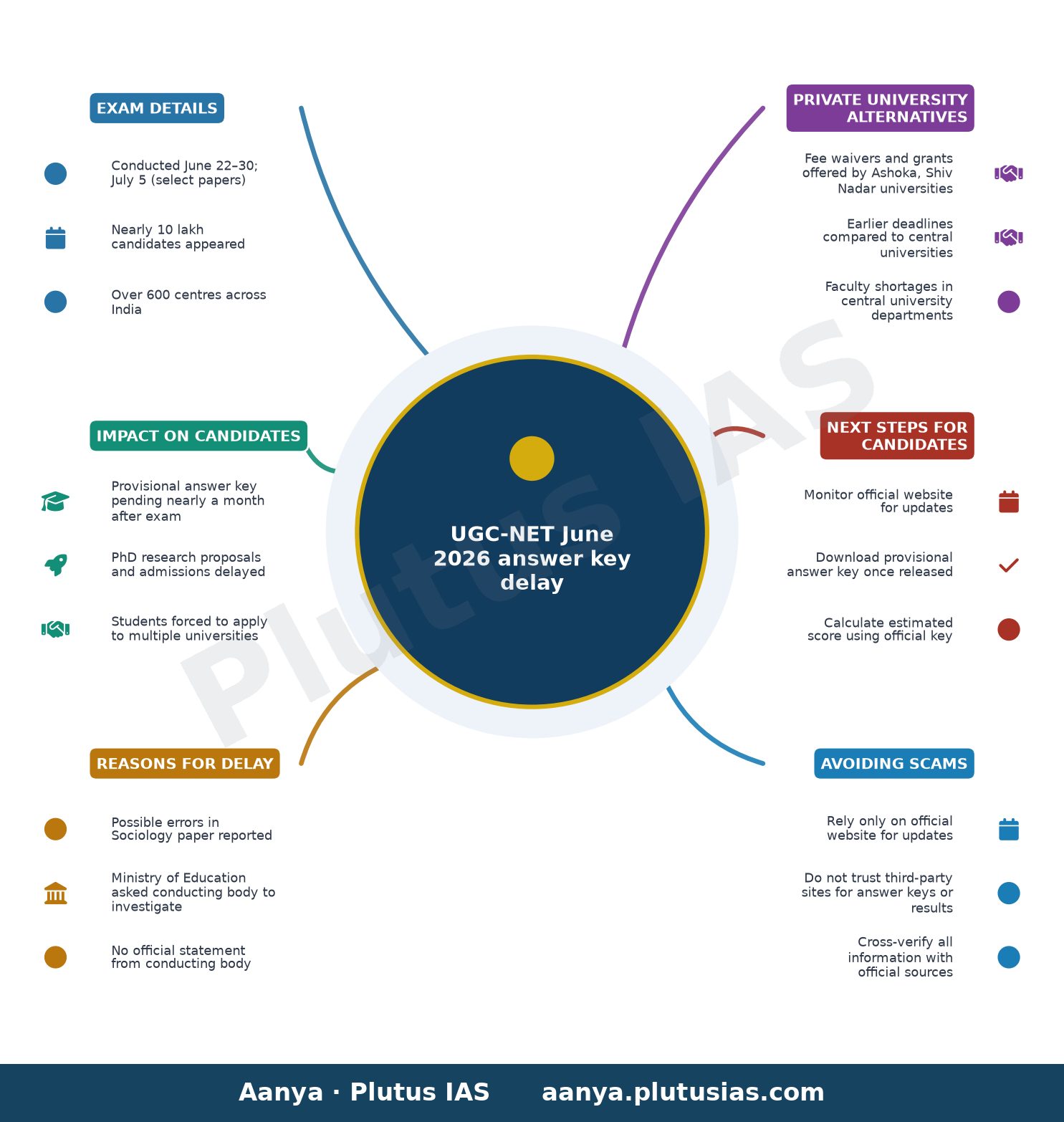
The provisional answer key for the June 2026 UGC-NET exam, conducted between June 22 and July 5, is still pending nearly a month after the final test date, leaving nearly 10 lakh candidates in limbo and forcing many to reconsider their PhD plans.
| Exam Session | Exam Dates | Estimated Candidates | Centres |
|---|---|---|---|
| June 2026 UGC-NET | June 22–30; July 5 (select papers) | Nearly 10 lakh | Over 600 |
Why the delay matters for PhD aspirants
For students like Purushottam, a master’s graduate in history from Mumbai who appeared in Jaipur, the absence of the provisional answer key has stalled every next step. “This year is clearly wasted for me,” he said. The UGC-NET score is the gateway to junior research fellowships (JRFs), assistant professor posts, and PhD admissions across India. Without the key, candidates cannot calculate their raw scores, let alone estimate their rank or eligibility for central university PhD programmes.
Anchal, who completed her Master’s in English from Jawaharlal Nehru University, pointed out that the delay also disrupts university timelines. “Last year, the PhD prospectus came out by the end of May, and applications closed by July,” she said. This year, universities are still waiting on the conducting body. “I’m expecting at least another four to six months, even if the results come out now,” she added.
Impact on research proposals and admissions
A student from Odisha, studying at a public university in Delhi, said the uncertainty is forcing her to apply to multiple universities simultaneously. “I have to hedge my bets because I’m not sure I’ll get into a central university in time,” she said. Her research proposal is on hold, and the delayed admission process risks eating into the semester itself.
Are protests or paper errors behind the hold-up?
Students’ groups and college unions have publicly asked the conducting body to explain the delay. Social media reports highlighted repetitive questions and possible errors in the Sociology paper, which may have prompted the Ministry of Education to ask the conducting body to investigate—potentially one reason for the hold-up. The conducting body has not issued an official statement on the matter.
Purushottam dismissed any link between protests and the answer key delay. “Releasing a provisional answer key doesn’t need fresh work. The questions already exist. You just need to compare them with the correct answers,” he said. The backdrop of the NEET-UG 2026 cancellation over an alleged paper leak and subsequent re-exam adds to the frustration, as students struggle to understand why a similar scrutiny isn’t being applied uniformly.
Private universities step in with fee waivers and grants
With central university departments facing faculty shortages and delayed admissions, privately funded universities are positioning themselves as viable alternatives. Purushottam noted that institutions like Ashoka University and Shiv Nadar University offer PhD scholars fee waivers and grants. “A student who has already spent so much during their master’s and their research proposal shouldn’t have to make such a choice,” he said.
The Delhi-based student agreed that financial constraints are pushing many toward central universities and institutes like Hyderabad Central University, IIT Delhi, and the Indian Statistical Institute. However, the delay in UGC-NET results is accelerating the shift toward private options, where deadlines are often earlier and funding more accessible.
What the conducting body’s usual timeline looks like
The conducting body typically releases the provisional answer key within 10 to 15 days of the exam. In the June 2023 session, it came within five days. This year, nearly a month has passed since the last exam date, and there is still no word from the agency. For an exam that decides eligibility for JRFs, assistant professor posts, and PhD admissions, the silence has left candidates unable to plan their next steps.
What candidates can do while waiting
While the conducting body has not provided an update, candidates can still prepare for the next steps once the provisional answer key is released. Here’s how to stay ready:
- Monitor the official website of the conducting body for any announcements regarding the provisional answer key, final answer key, and result declaration.
- Download the provisional answer key once released. Compare your recorded responses with the official key to estimate your raw score.
- Calculate your estimated score using the marking scheme provided in the exam notification. This will help you gauge your chances for JRF or assistant professor eligibility.
- Check eligibility criteria for PhD admissions in central and state universities. Some institutes may require UGC-NET qualification as a mandatory criterion for application.
- Prepare research proposals and statements of purpose in advance, even if universities have not opened applications yet. This will save time once deadlines are announced.
- Explore funding options from private universities, government scholarships, or research grants. Many institutes offer fee waivers or stipends for PhD scholars.
- Stay updated on university timelines by following the official websites of central universities and institutes where you plan to apply. Some may extend deadlines in light of the delay.
What happens after the provisional answer key is released?
Once the provisional answer key is published, candidates can raise objections within the stipulated timeframe. The conducting body will review the objections and release the final answer key, followed by the result. The result will include the candidate’s score, qualifying status, and eligibility for JRF or assistant professor posts. For PhD admissions, universities will use the UGC-NET score as one of the criteria, along with entrance tests, interviews, and research proposals.
Key documents to keep ready
- A copy of your UGC-NET admit card and response sheet.
- Your recorded responses for comparison with the provisional answer key.
- Proof of eligibility (Master’s degree certificate, caste certificate if applicable).
- Research proposal or statement of purpose for PhD applications.
How to avoid third-party sites and scams
Candidates should rely solely on the official website of the conducting body for updates, answer keys, results, and notifications. Avoid third-party websites claiming to provide early results, answer keys, or scorecards, as these may be scams or sources of misinformation. Always cross-verify any information with the official sources before taking action.
The conducting body has not issued any official statement regarding the delay in the provisional answer key. Students are advised to stay patient and keep checking the official website for updates. In the meantime, use this period to strengthen your research proposal, explore funding options, and prepare for PhD applications in both central and private universities.
Source: the official website of the conducting body — confirm every detail there before acting.
2026-08-04 — always confirm every detail on the official website of the conducting body before acting.
Related updates on OurEducation
- ICAR UG Round 1 Seat Allotment Result 2026 Out
- UGC NET June 2026 answer key release date and download steps
- CSIR UGC NET June 2026 answer key expected to be released soon at csirnet.nta.nic.in: Chec
- UGC NET June 2026 provisional answer key expected to be released soon at ugcnet.nta.nic.in
- When will NTA release UGC NET June 2026 answer key? Here’s what we know
Discover more from Our Education | Best Coaching Institutes Colleges Rank
Subscribe to get the latest posts sent to your email.
« NEET UG Counselling 2026 Registration JNU UG 2026 first merit list released »
Tell us Your Queries, Suggestions and Feedback