
73% Indian students drop out before higher secondary
Last Updated: Aug 13, 2026
Nearly 73% of Indian students drop out before completing higher secondary, a parliamentary panel has flagged, citing drastic declines in school and enrolment numbers at higher levels. The Tenth Report of the Committee on Estimates on “Budget and Policy aspects for providing Affordable and Quality Education in the Country including Review of Central Board of Secondary Education” presented to the Lok Sabha on Wednesday highlights severe gaps in infrastructure and accessibility, particularly for Divyang students.
| Education Level | Number of Schools | Number of Students Enrolled |
|---|---|---|
| Primary | 9,11,032 | 6,18,45,033 |
| Upper Primary | 4,12,805 | 4,08,93,978 |
| Secondary | 1,61,808 | 2,36,68,220 |
| Higher Secondary | 90,866 | 1,64,17,949 |
Key Findings from the Parliamentary Panel Report
Drastic Decline in Schools and Enrolment
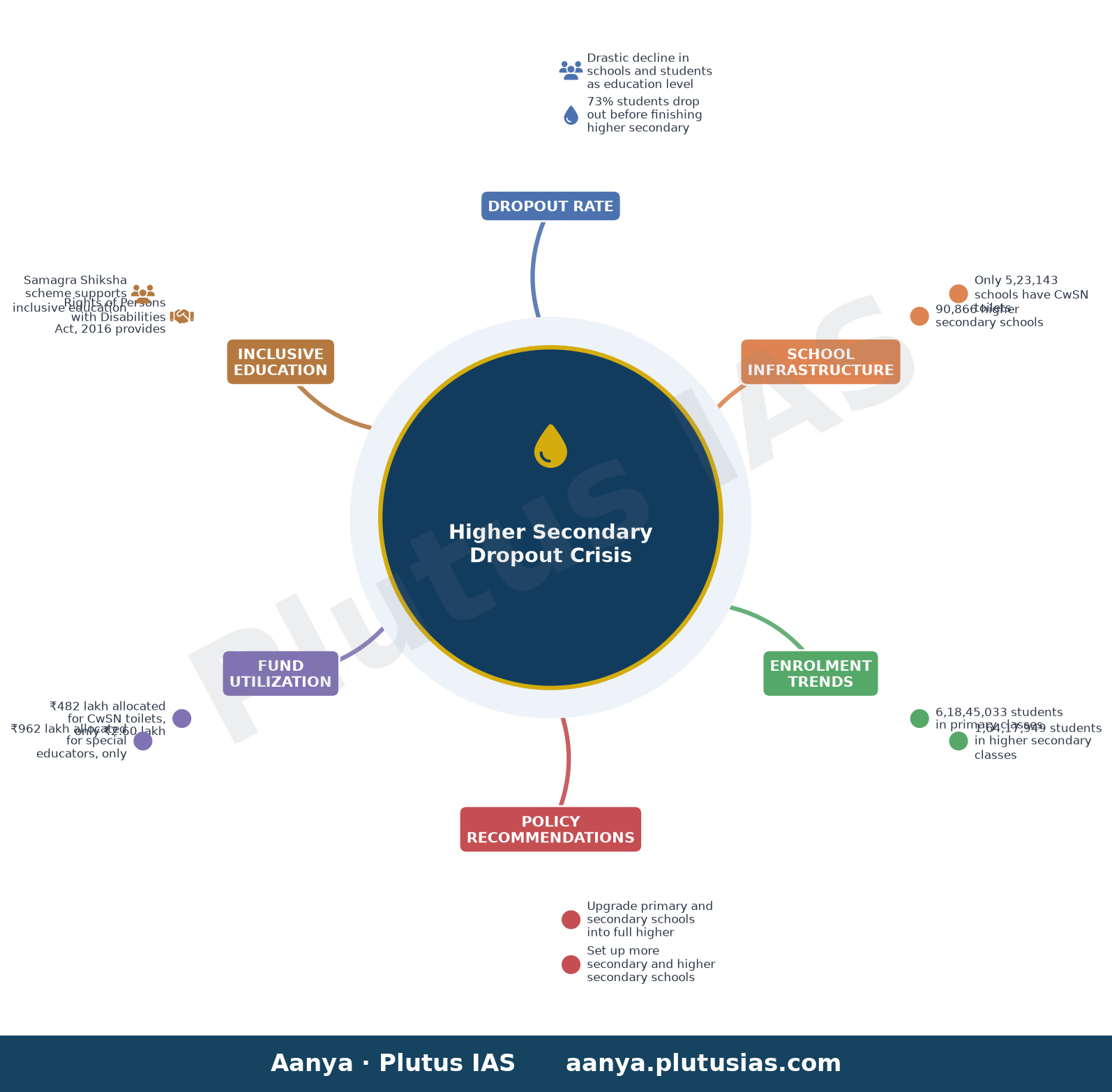
The committee observed a stark contrast between the number of schools and students at primary and higher secondary levels. While there are 9,11,032 primary schools with 6,18,45,033 students, the number of higher secondary schools drops to 90,866 with only 1,64,17,949 students. This represents a severe reduction in both infrastructure and participation as education levels rise.
73% Dropout Rate Before Higher Secondary
The report explicitly states that nearly 73% of students drop out before completing higher secondary education. The committee expressed concern over this trend, emphasizing the need for urgent intervention to address the declining enrolment and retention rates.
Recommendations to Improve Accessibility
The committee strongly urged the Ministry of Education to prioritize the upgrading of existing primary and secondary schools into full higher secondary schools. This measure aims to ensure that high schools are physically accessible to students from diverse communities and to reduce the dropout rate. The committee also called for setting up more secondary and higher secondary schools across states and union territories to increase enrolment.
Infrastructure Gaps for Divyang Students
Severe Lack of CwSN-Friendly Infrastructure
The committee highlighted a significant gap in the availability of infrastructure catering to Children with Special Needs (CwSN). As per UDISE 2024-25, out of 14,71,437 schools nationwide, only 5,23,143 have CwSN-friendly the medialets, and only 8,08,466 have ramps with handrails. More than half of the schools lack such facilities, severely limiting access for Divyang students.
Budgetary Allocations and Utilization
During 2024-25, a budget of ₹482 lakh was allocated for the construction of 186 CwSN the medialets, but only ₹2.60 lakh was utilized, with no progress in physical targets. Similarly, under the financial support for new special educators, only ₹80.50 lakh was utilized against a budgetary grant of ₹962 lakh. The committee noted minimal progress in recruiting and retaining special educators for CwSN students.
Ministry’s Approach to Inclusive Education
The committee acknowledged the Ministry of Education’s rights-based, inclusive, and holistic approach to promoting education for Divyang children. The Rights of Persons with Disabilities Act, 2016, is cited as providing free education to children with benchmark disabilities. However, the committee emphasized the need for better implementation and resource allocation to bridge the existing gaps.
Samagra Shiksha Scheme: Progress and Challenges
Financial Support for Inclusive Education
The Ministry of Education provides financial support to state governments and union territories under the Samagra Shiksha scheme to strengthen infrastructure and human resources for inclusive education. The scheme includes provisions for creating barrier-free and differently-abled-friendly infrastructure, such as ramps, handrails, and accessible the medialets.
Underutilization of Funds
Despite the allocations, the committee noted severe underutilization of funds. For instance, only ₹2.60 lakh was utilized out of ₹482 lakh allocated for CwSN the medialets, and ₹80.50 lakh out of ₹962 lakh for new special educators. The committee stressed the need for better planning and execution to ensure that funds are utilized effectively to achieve the scheme’s objectives.
Way Forward: Policy and Implementation
Need for State and UT Action
The committee emphasized that education is on the Concurrent List of the Constitution, with most schools under the jurisdiction of state governments and union territories. It urged the Ministry of Education to impress upon all state and UT governments to take proactive steps in setting up more secondary and higher secondary schools. This includes upgrading existing schools and ensuring that infrastructure is accessible to all students, including those with disabilities.
Strengthening Inclusive Education
To achieve the goal of inclusive education, the committee recommended that the Ministry of Education should focus on improving the availability of CwSN-friendly infrastructure. This includes constructing ramps, handrails, and accessible the medialets, as well as recruiting and retaining special educators. The committee also called for better monitoring and evaluation of the Samagra Shiksha scheme to ensure that funds are utilized effectively and targets are met.
How to Access the Report and Recommendations
-
Visit the official website of the conducting body to download the Tenth Report of the Committee on Estimates.
-
Navigate to the section on “Budget and Policy aspects for providing Affordable and Quality Education in the Country including Review of Central Board of Secondary Education.”
-
Locate the report presented to the Lok Sabha on Wednesday for detailed findings and recommendations.
-
Review the specific sections on school infrastructure, enrolment trends, and recommendations for Divyang students.
-
Use the report to understand the current challenges and policy measures proposed to address them.
Conclusion
The parliamentary panel’s report underscores critical gaps in India’s education system, particularly in secondary and higher secondary levels, and highlights the urgent need for infrastructure improvements and policy interventions. With nearly 73% of students dropping out before completing higher secondary, the focus must shift towards making education accessible and inclusive for all. The recommendations, if implemented effectively, could significantly improve enrolment and retention rates, ensuring that every student has the opportunity to complete their education.
Source: the official website of the conducting body — confirm every detail there before acting.
2026-08-13 — always confirm every detail on the official website of the conducting body before acting.
Related updates on OurEducation
- UPSC CAPF (AC): Exam Date, Notification & Latest Update
- UPSC NDA & NA (I): Exam Date, Notification & Latest Update
- UPSC CDS (I): Exam Date, Notification & Latest Update
- UPSC Engineering Services (ESE/IES): Exam Date, Notification & Latest Update
- UPSC Indian Forest Service (IFoS): Exam Date, Notification & Latest Update
Discover more from Our Education | Best Coaching Institutes Colleges Rank
Subscribe to get the latest posts sent to your email.
« AICTE-Mitacs Globalink Research Internship 2027 SSC MTS: Exam Date, Notification & Latest Update »
Tell us Your Queries, Suggestions and Feedback