
FMGE June 2026: NBEMS rejects cut-off cut, proposes reforms
Last Updated: Aug 27, 2026
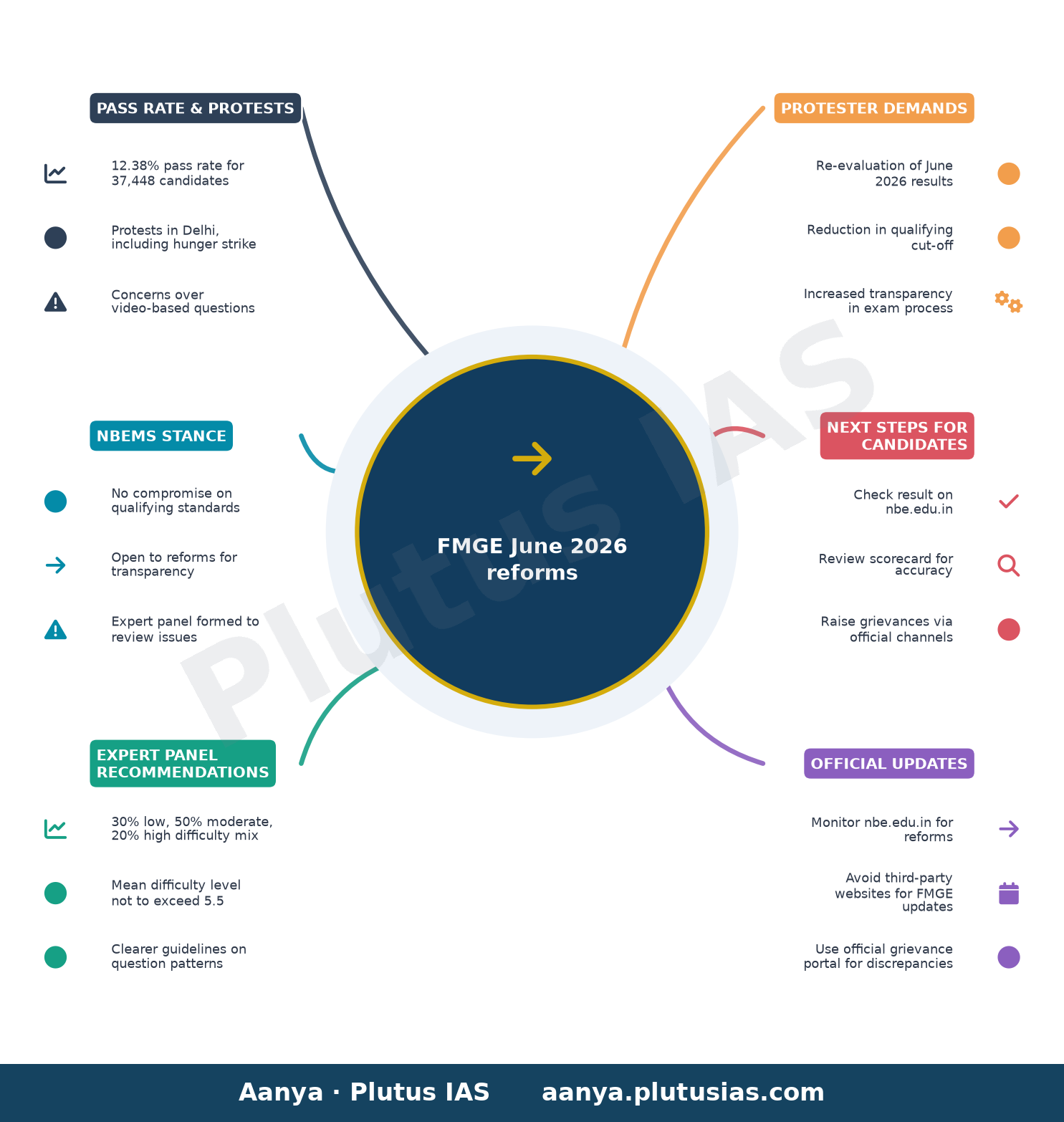
The National Board of Examinations in Medical Sciences (NBEMS) has firmly refused to lower the qualifying standards for the June 2026 Foreign Medical Graduate Examination (FMGE), even as protests intensify over a record-low pass percentage of 12.38% among 37,448 candidates.
| Parameter | June 2026 FMGE Data |
|---|---|
| Total candidates appeared | 37,448 |
| Overall pass percentage | 12.38% |
| Proposed difficulty mix (expert panel) | 30% low, 50% moderate, 20% high |
| Proposed mean difficulty level | Not to exceed 5.5 |
Why the June FMGE pass rate sparked nationwide protests
The June 2026 FMGE witnessed an unprecedented low pass rate of 12.38%, with only 4,636 candidates qualifying out of 37,448 examinees. The sharp decline has triggered mass protests in Delhi, particularly in the Gautam Nagar area, where foreign medical graduates (FMGs) have staged demonstrations. A section of protesters has also resorted to a hunger strike, demanding a review of the examination pattern and immediate relief measures.
The protests intensified after candidates raised concerns over the inclusion of video-based questions in the FMGE. While the National Medical Commission (NMC) defended the use of such questions, arguing that they assess clinical decision-making rather than rote memorization, candidates argue that the format contributed to the unusually low pass rate. The NMC emphasized that video-based questions were designed to evaluate a candidate’s ability to identify and respond to real-life clinical scenarios, aligning with the evolving demands of medical practice in India.
NBEMS stands firm on competency standards
Despite the mounting pressure, NBEMS has categorically stated that it will not compromise on the minimum competency standards required for doctors seeking to practice in India. A senior NBEMS official clarified that while genuine concerns raised by FMGs would be considered, the board would not lower the qualifying benchmarks. The official added that examination reforms could be introduced to enhance transparency and fairness, but the core competency expectations would remain unchanged.
The decision comes as a relief to the medical fraternity, which has consistently emphasized the need for high standards to ensure patient safety. The NBEMS stance underscores its commitment to maintaining the integrity of the FMGE while addressing procedural concerns raised by candidates.
Expert panel formed to recommend reforms
In response to the widespread criticism, NBEMS constituted a three-member expert committee to examine the issues raised by FMGs. The committee is headed by Air Marshal (Dr) Pawan Kapoor (Retd) and includes experts from the medical and educational domains.
Key recommendations from the expert panel
- Balanced difficulty mix: The panel has proposed a structured distribution of question difficulty, with 30% low-difficulty questions, 50% moderate-difficulty questions, and 20% high-difficulty questions. This approach aims to provide a more predictable and fair assessment of candidates’ knowledge and skills.
- Mean difficulty threshold: The committee has recommended that the mean difficulty level of the FMGE paper should not exceed 5.5 on a standardized scale. This measure is intended to prevent excessive deviation in the difficulty level of the examination from year to year.
- Transparency in question patterns: The panel has suggested that NBEMS should provide clearer guidelines on the types of questions that may appear in the FMGE, including the proportion of video-based, image-based, and text-based questions. This move aims to reduce ambiguity and help candidates prepare more effectively.
The expert panel’s recommendations are currently under review by NBEMS, and further updates are expected in the coming weeks. While the board has not committed to implementing all suggestions, it has indicated openness to reforms that enhance the examination process without compromising on standards.
Protests continue as FMGs demand immediate relief
The protests in Delhi show no signs of abating, with FMGs continuing to demand immediate relief measures. Protesters have raised several demands, including:
- A re-evaluation of the June 2026 FMGE results.
- A reduction in the qualifying cut-off for the June session.
- Increased transparency in the examination process, including the release of sample video-based questions for practice.
- A review of the role of video-based questions in assessing clinical competence.
While NBEMS has not indicated any immediate changes to the results or cut-offs, it has assured candidates that their concerns are being taken seriously. The board has also urged FMGs to approach the official channels for grievance redressal rather than resorting to protests.
What FMGs should do next: A step-by-step guide
- Check your result: Visit the official FMGE portal at nbe.edu.in and log in using your credentials to download your scorecard. The scorecard will display your marks, qualifying status, and other relevant details.
- Review the scorecard: The scorecard will contain your roll number, marks obtained in each section, and your overall score. Ensure that all details are accurate and report any discrepancies to NBEMS immediately.
- Understand the qualifying criteria: The FMGE requires candidates to secure a minimum of 50% in the aggregate and at least 50% in each subject to qualify. The June 2026 session’s low pass rate highlights the importance of thorough preparation.
- Prepare for potential reforms: If the expert panel’s recommendations are implemented, the FMGE may see changes in the question paper pattern. Candidates are advised to stay updated with official announcements on nbe.edu.in.
- Raise grievances through official channels: If you believe there was an error in the evaluation or administration of the exam, submit a formal grievance to NBEMS via their official portal. Avoid relying on third-party websites or agents for assistance.
- Plan your next steps: For candidates who did not qualify, consider re-appearing for the next FMGE session after thorough preparation. Review the examination pattern, focus on weak areas, and utilize official resources for practice.
Balancing fairness and standards: The way forward
The June 2026 FMGE controversy has highlighted the delicate balance between maintaining high medical standards and ensuring fairness for candidates. While NBEMS has made it clear that it will not lower the qualifying benchmarks, the expert panel’s recommendations signal a willingness to reform the examination process to make it more transparent and candidate-friendly.
The proposed reforms, including a balanced difficulty mix and clearer guidelines on question patterns, could address some of the concerns raised by FMGs. However, the ultimate goal remains the same: to ensure that only competent doctors are allowed to practice in India, thereby safeguarding patient safety and upholding the integrity of the medical profession.
As the situation evolves, candidates are advised to stay informed through official channels and avoid misinformation. The official website nbe.edu.in will be the primary source for updates on the FMGE and any reforms that may be implemented in the coming months.
Official source: nbe.edu.in — confirm every detail here before acting.
2026-08-27 — always confirm every detail on the official website of the conducting body before acting.
Related updates on OurEducation
- Scholarship for MBBS in Russia
- MBBS in Philippines
- Cheapest colleges of MBBS in Nepal
- Best MBBS College in Philippines for Indians
- Best FMGE Coaching in Chennai
Discover more from Our Education | Best Coaching Institutes Colleges Rank
Subscribe to get the latest posts sent to your email.
« Schedule of Dossier Verification for Recruitment to the post of Insurance Medical Officer (IMO) Grade-II in ESIC through CMSE 2024 from Prat Delhi Police Constable PE&MT 2025 Postponed »
Tell us Your Queries, Suggestions and Feedback