
IIMs mull common UG entrance test and centralised MBA
Last Updated: Sep 22, 2026
The Indian Institutes of Management (IIMs) are actively exploring a common undergraduate entrance test and a centralised counselling platform for MBA admissions, as revealed in minutes of a high-level meeting chaired by the then Union Education Minister Dharmendra Pradhan on May 14, 2026.
| Proposed Change | Current Status | Key Discussion Points |
|---|---|---|
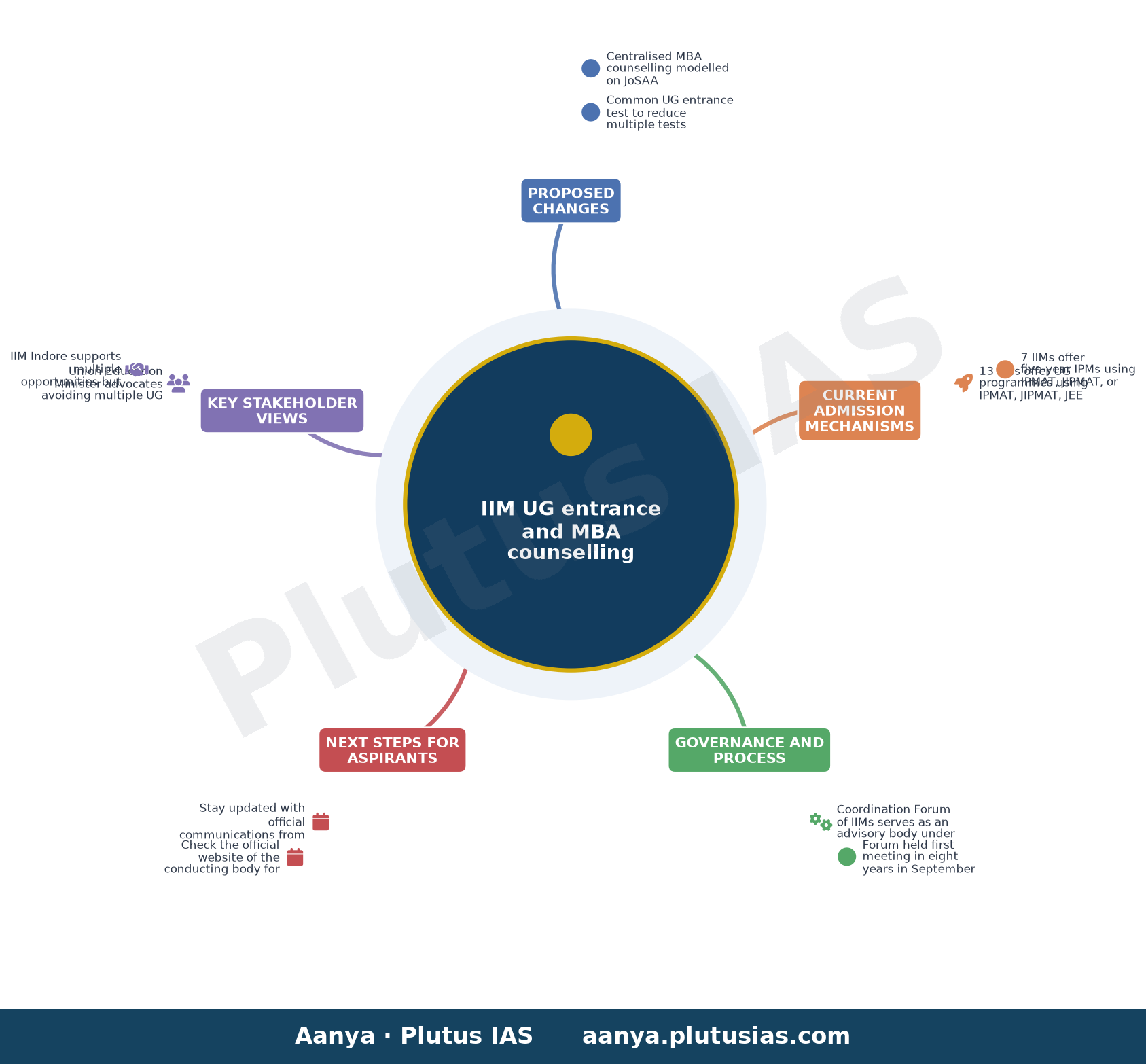
| Common UG Entrance Test | 13 IIMs offer UG programmes using 3+ admission mechanisms (IPMAT, JIPMAT, IIM Rohtak’s own test, JEE Advanced, JEE Main, IIMB Undergraduate Admissions Test, BMS Aptitude Test, or no test) | Reduce multiple tests; align with JEE, CUET, CLAT or leverage existing frameworks; avoid creating new tests |
| Centralised MBA Counselling | Candidates pay non-refundable seat-booking amounts at multiple IIMs before choosing one | Modelled on JoSAA for IITs; allow candidates to freeze, slide or float choices; reduce financial losses and seat blocking |
| Uniform Fee-Refund Policy | No uniform policy currently exists | Develop standard operating procedures (SOPs) for fee refunds across IIMs |
| Inter-IIM Student Transfers | No formal policy exists | Discuss policies on inter-IIM student migration and transfer mechanisms |
Why the IIMs are pushing for a common UG entrance test
The IIMs currently use a fragmented approach for undergraduate admissions, with 13 of the 22 IIMs offering UG programmes through multiple entrance examinations. The existing mechanisms include IPMAT (used by IIM Indore, Rohtak, Sambalpur, Sirmaur), JIPMAT (IIM Bodh Gaya, Jammu, Amritsar, Ranchi), IIM Rohtak’s own aptitude test, JEE Advanced (IIM Lucknow), JEE Main (IIM Mumbai), IIMB Undergraduate Admissions Test (IIM Bangalore), BMS Aptitude Test (IIM Kozhikode), and even admissions without an entrance test (IIM Udaipur).
The minutes of the Coordination Forum of IIMs meeting highlight that the Union Education Minister Dharmendra Pradhan emphasized avoiding multiple UG entrance tests, stating that they impose a financial burden on students and cause unnecessary stress. Pradhan clarified that this move is not an attempt at government interference but rather a stakeholder-driven effort to streamline the admission process.
IIM Indore, which pioneered the Integrated Programme in Management (IPM) in 2011, argued that multiple tests provide students with multiple opportunities and accommodate diverse programme requirements. However, it also acknowledged the financial burden of multiple application and admission processes and proposed that IIMs planning to offer IPM join the existing IPMAT framework, backed by IIM Rohtak.
On the other hand, IIM Bodh Gaya, Jammu, Amritsar, and Ranchi supported the idea of a common entrance test, with Jammu and Bodh Gaya favoring one conducted by the National Testing Agency (NTA). IIM Kozhikode advocated for minimal regulation and flexibility for individual IIMs, while IIM Udaipur suggested using existing scores from JEE, CUET, and CLAT instead of introducing another test.
Leveraging existing examinations to reduce redundancy
Several IIMs have already started aligning their UG programmes with existing national-level entrance examinations. For instance, IIM Lucknow’s BS in Artificial Intelligence & Business Analytics uses JEE Advanced, while IIM Mumbai’s BS in Digital Science and Business Management uses JEE Main. IIM Sambalpur and IIM Sirmaur use IPMAT, and IIM Bangalore conducts its own IIMB Undergraduate Admissions Test. IIM Kozhikode uses the BMS Aptitude Test, and IIM Udaipur admits students to its BBA programme without an entrance examination.
IIM Indore director Himanshu Rai emphasized that the broader consensus was to avoid creating new entrance tests and instead leverage credible examinations that already exist. This approach aims to reduce the financial burden on students and simplify the admission process across IIMs.
Centralised counselling for MBA admissions: A JoSAA-like model
The Coordination Forum of IIMs also discussed the need for a common counselling mechanism for MBA admissions, modelled on the Joint Seat Allocation Authority (JoSAA) system used by IITs. The current system requires candidates to pay non-refundable seat-booking amounts at multiple IIMs before finalizing their choice, leading to financial losses and seat blocking for other candidates.
A centralised digital platform would allow candidates to freeze, slide, or float their choices, similar to the JoSAA system. This would reduce the financial burden on students and ensure a more transparent and efficient admission process. IIM Mumbai was tasked with developing a framework for this common counselling mechanism.
Uniform fee-refund policy and inter-IIM student transfers
The forum discussed the need for a uniform fee-refund policy across IIMs to provide clarity and consistency for students. Currently, each IIM follows its own refund policy, which can vary significantly and cause confusion for students and parents. Developing standard operating procedures (SOPs) for fee refunds would ensure fairness and transparency in the admission and withdrawal process.
Additionally, the forum explored policies on inter-IIM student migration and transfers. This would allow students to transfer between IIMs based on academic fit, personal circumstances, or other valid reasons, fostering greater mobility and flexibility within the IIM system. No formal policy currently exists for such transfers, and the forum aims to develop a structured approach to address this gap.
Governance and the role of the Coordination Forum of IIMs
The Coordination Forum of IIMs, chaired by the then Union Education Minister Dharmendra Pradhan, serves as an advisory body under the Indian Institute of Management Act, 2017. Unlike the IIT Council, whose decisions are binding on IITs, the forum’s recommendations are not mandatory but are intended to guide the IIMs in aligning their policies and practices.
The forum held its first meeting in eight years in September 2025, followed by a second meeting on May 14, 2026. The education ministry circulated the minutes of the meeting to all IIMs on June 17, 2026. The minutes were obtained through a Right to Information (RTI) application on September 15, 2026.
The forum’s discussions reflect a broader effort to modernize the IIM system, improve student mobility, and reduce the administrative and financial burden on candidates. While the decisions are not binding, they signal a shift towards greater coordination and standardization across the IIMs.
What’s next for aspirants and current students?
For aspirants planning to apply to UG or MBA programmes at IIMs, the proposed changes could significantly impact the admission process. If a common UG entrance test is implemented, students may no longer need to appear for multiple tests, reducing both financial and psychological stress. Similarly, a centralised counselling platform for MBA admissions would simplify the process of securing a seat and reduce the financial burden associated with seat blocking.
Current students may benefit from a uniform fee-refund policy and policies on inter-IIM student transfers, which would provide greater flexibility and clarity in managing their academic journeys. However, these changes are still under discussion, and aspirants should stay updated with official communications from the IIMs.
The forum’s recommendations are expected to undergo further analysis, including an assessment of students’ test-taking patterns and socio-economic backgrounds, before any final decisions are made. The higher education secretary Vineet Joshi emphasized that such a significant decision could not be finalized in a single meeting and required thorough deliberation.
How to stay informed about IIM admissions
To stay informed about the latest developments in IIM admissions, aspirants should regularly check the official website of the conducting body. The official website will provide updates on any changes to entrance examinations, counselling processes, fee structures, and other admission-related policies. Avoid relying on third-party websites or unofficial sources for critical information.
Key takeaways for aspirants and stakeholders
- A common UG entrance test is under consideration to reduce the financial and psychological burden on students.
- A centralised counselling platform for MBA admissions, modelled on JoSAA, is being explored to streamline the process and reduce seat blocking.
- A uniform fee-refund policy and policies on inter-IIM student transfers are also under discussion to improve transparency and flexibility.
- The Coordination Forum of IIMs serves as an advisory body, and its recommendations are not binding but aim to guide the IIMs in aligning their policies.
- Stay updated with official communications from the IIMs to ensure you have the most accurate and up-to-date information.
Frequently Asked Questions
-
Will the IIMs introduce a common UG entrance test for all programmes?
The IIMs are considering a common UG entrance test to reduce the number of tests and streamline admissions. However, no final decision has been made yet. The forum is still deliberating on whether to create a new test or leverage existing examinations like JEE, CUET, or CLAT.
-
How will the centralised counselling platform for MBA admissions work?
The proposed platform, modelled on JoSAA for IITs, would allow candidates to freeze, slide, or float their choices. This would reduce the financial burden of paying non-refundable seat-booking amounts at multiple IIMs and ensure a more transparent admission process. IIM Mumbai has been tasked with developing the framework.
-
What is the role of the Coordination Forum of IIMs?
The Coordination Forum of IIMs serves as an advisory body under the Indian Institute of Management Act, 2017. It discusses critical issues related to admissions, student mobility, and policy standardization across IIMs. Its recommendations are not binding but guide the IIMs in aligning their practices.
-
Will the proposed changes affect current students?
The proposed changes, such as a uniform fee-refund policy and policies on inter-IIM student transfers, could benefit current students by providing greater flexibility and clarity. However, these changes are still under discussion, and students should stay updated with official communications from the IIMs.
-
How can aspirants stay informed about the latest developments in IIM admissions?
Aspirants should regularly check the official website of the conducting body for updates on entrance examinations, counselling processes, fee structures, and other admission-related policies. Avoid relying on third-party websites or unofficial sources for critical information.
Source: the official website of the conducting body — confirm every detail there before acting.
2026-09-22 — always confirm every detail on the official website of the conducting body before acting.
Related updates on OurEducation
- Maharashtra CET 2026 BE-BTech Admissions Full Details
- IIM CAT 2026 registration ends today, admit card release date
- AIMA MAT Admit Card 2026 for PBT releasing today
- UPSC Civil Services (Main) Examination 2026 — Economics Optional Paper II Analysis, Trends
- UPSC Civil Services (Main) Examination 2026 — Philosophy Optional Paper I Analysis, Trends
Related guides on our sites
- Prelims test series
- UPSC EPFO Test series
- Anthropology optional test series
- Best PSIR optional test series
Discover more from Our Education | Best Coaching Institutes Colleges Rank
Subscribe to get the latest posts sent to your email.
Tell us Your Queries, Suggestions and Feedback