
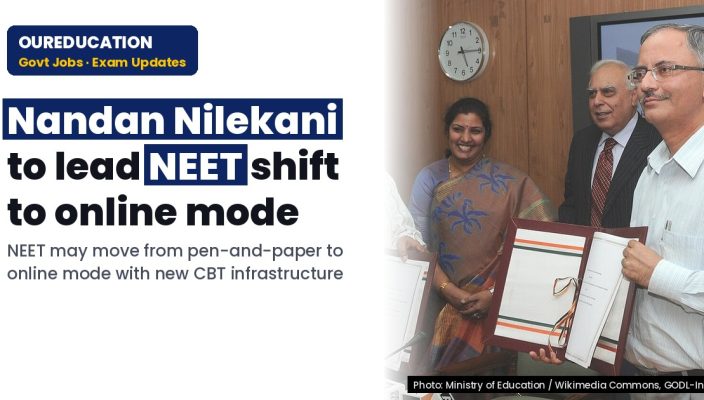
NEET moving online: CBT upgrade plan for future exams
Last Updated: Oct 1, 2026
The Ministry of Education is building a national Computer-Based Testing (CBT) infrastructure to prepare NEET-UG for a possible shift from pen-and-paper to online mode, aiming to standardise test centres and close geographic gaps. The plan includes increasing test centre availability, standardising infrastructure, and ensuring reliable connectivity and security for over 25 lakh candidates who appear for NEET each year.
| Key Aspect | Detail |
|---|---|
| Current NEET mode | Pen-and-paper with OMR sheets |
| Annual NEET candidates | Nearly 25 lakh |
| Task force setup | July |
| Task force led by | Nandan Nilekani |
| Task force mandate | Comprehensive reforms in conduct, security, design, and governance of public examinations |
| Previous committee | Radhakrishnan committee (post-2024 NEET-UG paper leak) |
Why is NEET moving online?
The Education Ministry is preparing a national CBT infrastructure strategy to address long-standing concerns about NEET’s pen-and-paper format, including geographic disparities in test centre availability and risks of malpractice such as paper leaks. The shift aims to standardise examination conditions across states, improve security, and enable faster result processing. The move is part of a broader push for examination reforms led by the Nandan Nilekani-led High-Powered Task Force, which is consulting experts and stakeholders to recommend systemic changes.
Addressing rural and women candidates
The government is examining the impact of a CBT transition on rural candidates, women, and students in districts with poor internet connectivity. The strategy includes plans to expand test centre networks, provide reliable connectivity, and ensure comparable conditions for all candidates, regardless of location.
Infrastructure overhaul: What’s being planned?
The CBT infrastructure plan focuses on three key areas: increasing test centre availability, standardising equipment and connectivity, and ensuring robust security arrangements. The system will need standardised computers, reliable power backup, and secure networks to handle the scale of NEET, which attracts nearly 25 lakh candidates annually. The infrastructure is also being designed to support other national entrance examinations conducted by the NTA, including JEE-Main, CUET-UG, CUET-PG, UGC-NET, and CSIR-UGC-NET.
Sequencing the transition
The transition from pen-and-paper to CBT will involve careful sequencing to minimise disruption. The government is examining the infrastructure needs, the timeline for the shift, and the availability of centres. A final decision on the transition will be taken only after the Nilekani-led task force submits its recommendations, which are expected soon.
Role of the Nilekani task force
The High-Powered Task Force on examination reforms, led by Nandan Nilekani, was set up in July to recommend comprehensive reforms in the conduct, security, design, and governance of public examinations. The task force is consulting experts, including former ISRO chairman K Radhakrishnan, who headed the earlier committee tasked with recommending reforms to the NTA after the 2024 NEET-UG paper leak. The task force’s recommendations will shape the future of NEET and other national entrance examinations.
Supreme Court’s role in reforms
The Supreme Court has asked the Centre to provide details of the steps taken to implement the recommendations of the Radhakrishnan committee and the Nilekani task force. The top court has stressed that reforms to the NEET process should be institutionalised rather than depend on temporary arrangements, highlighting the need for systemic changes to prevent future malpractice.
Challenges and considerations
The scale of NEET makes the transition to CBT particularly demanding. The system will need to ensure that candidates across the country have comparable examination conditions, including reliable connectivity, power backup, and standardised equipment. The government is also considering the impact on rural candidates and women, who may face additional challenges in accessing online testing centres.
Broader impact on other exams
Once the national CBT infrastructure is in place, the government aims to enable the migration of other pen-and-paper entrance examinations to CBT mode. This would include exams conducted by the NTA and other agencies, making the system more efficient, secure, and scalable. The infrastructure being planned for NEET could serve as a model for a wider shift towards computer-based national entrance examinations in the coming years.
How to stay updated on NEET reforms
- Visit the official website: Check neet.nta.nic.in regularly for official announcements on NEET reforms, including any updates on the CBT transition.
- Follow the NTA: The National Testing Agency (NTA) will release official communications regarding examination modes, infrastructure upgrades, and timelines. Monitor their website and social media channels for updates.
- Subscribe to official notifications: Sign up for email or SMS alerts from the NTA to receive timely updates on NEET-related reforms and changes.
- Check task force reports: The Nilekani-led task force’s recommendations will be published on the Ministry of Education’s official website. Review these documents to understand the proposed changes to NEET.
- Avoid third-party sources: Do not rely on unofficial websites or social media for information about NEET reforms. Always verify details with the official sources mentioned above.
What candidates should know
While the transition to CBT is under consideration, NEET will continue to be conducted in its current pen-and-paper format until a final decision is made. Candidates should focus on preparing for the exam as usual, but stay informed about any changes to the examination mode or infrastructure. The NTA will provide detailed guidelines and support for candidates transitioning to CBT, including mock tests and practice sessions to familiarise them with the new format.
Future of NEET and national exams
The CBT infrastructure plan is part of a larger effort to modernise the examination system in India. By standardising test centres, improving security, and enabling faster result processing, the government aims to create a more efficient and reliable system for national entrance examinations. The success of this transition for NEET could pave the way for similar changes in other exams, making the process more accessible and secure for all candidates.
Official source: neet.nta.nic.in — confirm every detail here before acting.
2026-09-30 — always confirm every detail on the official website of the conducting body before acting.
Related updates on OurEducation
- IIMs mull common UG entrance test and centralised MBA
- CAPF BSF: LINK FOR OBJECTION MANAGEMENT PORTAL OF CBT EXAM
- ESIC Corrigendum – (Advertisement No. 06 of 2025) for
- Punjab Lecturer Cadre Admit Card 2026 released
- AIIMS NORCET 11 Admit Card 2026 Released Today
Related guides on our sites
Discover more from Our Education | Best Coaching Institutes Colleges Rank
Subscribe to get the latest posts sent to your email.
Tell us Your Queries, Suggestions and Feedback