
Questions on IC Engines with answers
Last Updated: Aug 27, 2013
An automobile engineer or a mechanical engineer is required to go through the depths of the IC engine portion as they might have to answer a numerous questions be it in the interview or in academics. So here is a set of some frequently asked questions on IC engines with answers
AN 2-STROKE engine is designed by DUGLAD CLERK in 1880, the suction,compression,expansion and exhaust takes place during 2-stroke of piston.Their is 1 stroke after every revolution of the crank shift.

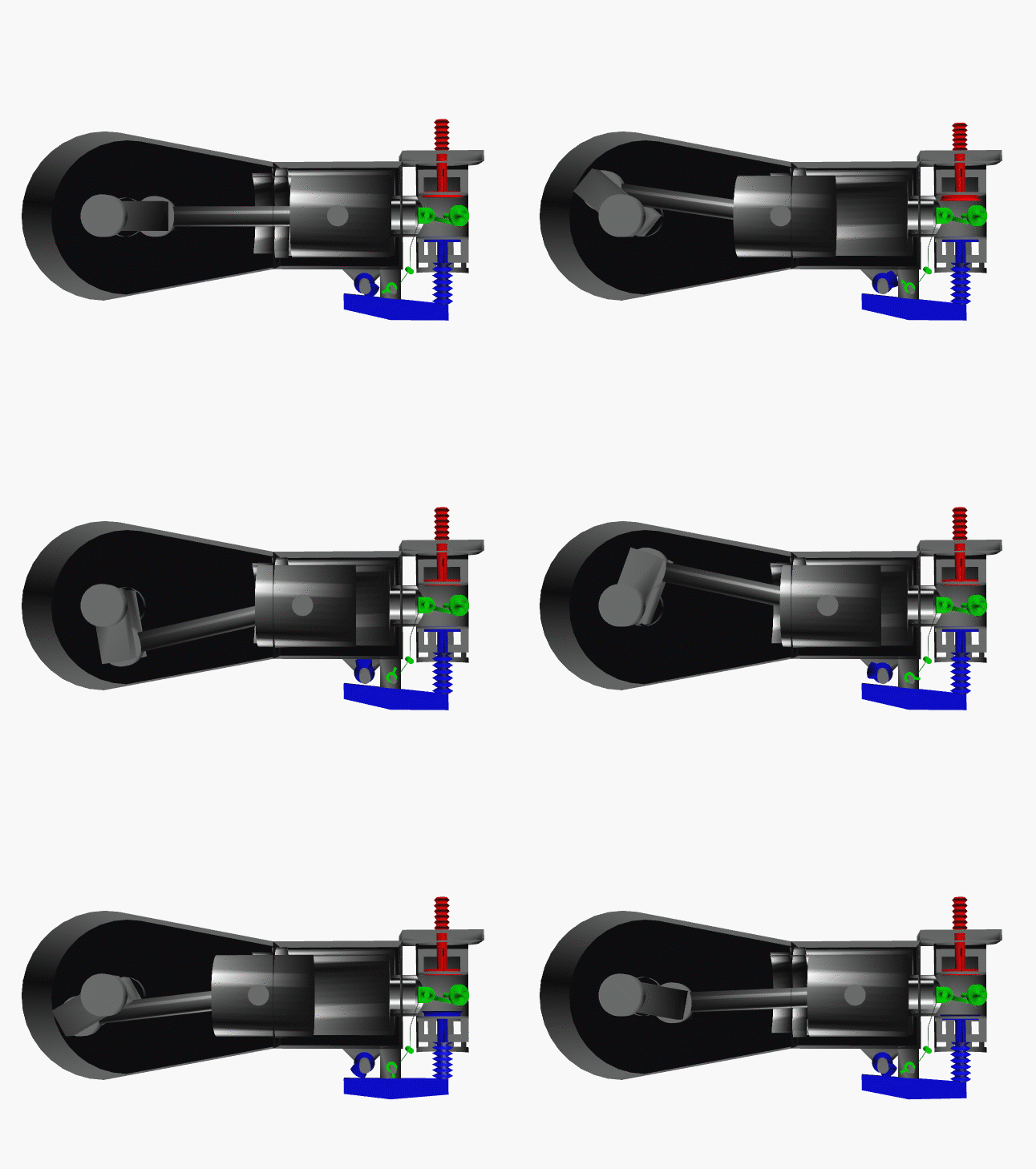
2-Stroke IC Engine

Animation of two-stroke engine in operation, with a tuned pipe exhaust.
ANS.
- 2-stroke engine fires 1 time in each revolution whereas a 4-stroke fires 1 time in 2 revolutions.
- 2-stroke is simpler and lighter, but less versatile.
- In place of valves in 4-stroke engines ,ports are present in 2-stroke engines,stroke has no valve, the piston act like a valve to control the flow of fuel..
- light duty engines are 2 stroke used commonly, for heavy duty 4 stroke are used.
5. NAME THE MAIN STEPS INVOLVE IN 4-STROKE IC ENGINE?
ANS.Following are the steps involved in this are:
The steps involved here are:
- Intake stroke: Air and vaporized fuel are drawn in.
- Compression stroke: Fuel vapor and air are compressed and ignited.
- Combustion stroke: Fuel combusts and piston is pushed downwards.
- Exhaust stroke: Exhaust is driven out. During the 1st, 2nd, and 4th stroke the piston is relying on power and the momentum generated by the other pistons.

Four Stroke Cycle
Four-stroke cycle (or Otto cycle)
1. Intake
2. Compression
3. Power
4. Exhaust
- automobiles: such as helicopters, big barges and ships and jet crafts utilize excess power which is supplied in the form of gas turbines.
- aircraft vehicles,
- motorbikes,
- boats and other locomotives.
- major power plants and similar naval applications,
- Battery operated electric vehicles
7.WHAT ARE THE ADVANTAGES OF LUBRICATION IN IC ENGINE?
ANS .Following are the advantages of lubrication in IC engine:
- It reduces the wear and tear of the moving parts.
- It damps down the vibration of the engine.
- It cleans the moving parts.
- It makes the piston gas tight.
8. NAME THE COMMON LAYOUT OF THE IC ENGINE?
ANS. Following are the common layouts of the IC engine:
- Reciprocating:
- Two-stroke engine
- Four-stroke engine (Otto cycle)
- Six-stroke engine
- Diesel engine
- Atkinson cycle
- Miller cycle
- Rotary:
- Wankel engine
- Continuous combustion:
Gas turbine
- Jet engine
9. NAME THE FUEL USED BY IC ENGINES?
ANS. Following are the types of fuels used for IC engines:
- Petroleum: Petroleum spirit ,Petroleum diesel,liquified petroleum gas,Compressed natural gas,Jet fuel ,Residual fuel.
- Coal: methanol ,Gasoline ,Diesel fuel.
- Biofuels and vegoils: Peanut oil and other vegoils , Biobutano, biodiesel ,Dimethyl Ether, biogas,hydrogen
10.WHAT ARE THE MEASURES OF IC ENGINE PERFORMANCE?
ANS. Engine types vary greatly in a number of different ways and following are it’s measures of performance:
- energy efficiency
- fuel/propellant consumption
- power-to-weight ratio
- thrust to weight ratio
- Torque curves (for shaft engines) thrust lapse (jet engines)
- Compression ratio for piston engines, overall pressure ratio for jet engines and gas turbines
We hope that set of questions on IC engine provided here have helped you in some way. Please give your valuable feedback regarding this post so that we can come up with more and more helpful posts like this.
Related Search:
Discover more from Our Education | Best Coaching Institutes Colleges Rank
Subscribe to get the latest posts sent to your email.
Tell us Your Queries, Suggestions and Feedback
58 Responses to Questions on IC Engines with answers
« Important Questions on C++ OnLine Analytical Processing (OLAP) questions »
related qeustions ot ic engine
ic engine
ic engine