
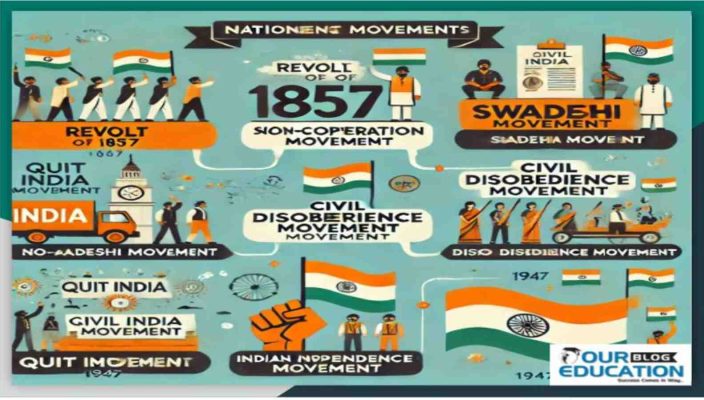
Important National Movement Of India
Last Updated: Mar 10, 2025
Dear Students,
Indian National Movement from 1905 to 1920 was a pivotal period in the country’s struggle for independence. Here are some of the key events that took place during this time. Here, we will discuss the Important National Movement of India.
Important National Movement in India: 1905-1920
The Indian National Congress:
A. O. Hume, an Englishman and a retired civil servant, formed the Indian National Congress in 1885. W. C. Banerjee presided over the first session, and 72 delegates attended it, which was held in Bombay in 1885.
Partition of Bengal:
Lord Curzon formed East Bengal and Assam on October 16, 1905, through a royal proclamation. He reduced the old province of Bengal in size by creating East Bengal and Assam out of the rest of Bengal. The motto of this was to set up a communal gulf between Hindus and Muslims.
Swadeshi Movement (1905): For this movement,
Lal, Bal, Pal, and Aurobindo Ghosh played important roles.INC took the Swadeshi call first at the Banaras Session, 1905, presided over by G. K. Gokhale. Bonfires of foreign goods were conducted at various places.
Formation of the Muslim League (1906):
Aga Khan, Nawab Salimullah of Dhaka, and Nawab Mohsin-ul-Mulk formed the All India Muslim League in 1906. They established it as a loyalist, communal, and conservative political organization. The leaders actively supported the partition of Bengal and opposed the Swadeshi movement. It demanded special safeguards to its community and a separate electorate for Muslims.
Demand for Swaraj:
In December 1906, at Calcutta, the INC under Dadabhai Naoroji adopted ‘Swaraj’ (Self-govt) as the goal of Indian people. Surat Session of Indian National Congress (1907): The INC had divided into two groups- The extremists and the moderates- at the Surat session in 1907. Extremists were led by Bal, Pal, and Lal, while the moderates were led by G. K. Gokhale.
Indian Councils Act or Minto Morley Reforms (1909) –
It called for a separate electorate for Muslims. It aimed at dividing the nationalist ranks and at rallying the Moderates and the Muslims to the Government’s side.
Ghadar Party (1913)
Lala Hardayal, Taraknath Das, and Sohan Singh Bhakna set up the Ghadar Party. They established its headquarters in San Francisco.
Home Rule Movement (1916)
It was started by B. G. Tilak (April, 1916) at Poona and Annie Besant and S. Subramania Iyer at Adyar, near Madras (Sept, 1916). The aim was to initiate a self-government for India in the British Empire. Tilak had linked up the question of Swaraj with the demand for the formation of Linguistic States and education in vernacular language. He gave the slogan: Swaraj is my birthright right, and I will have it.
Lucknow Pact (1916):
This resulted in a war between Britain and Turkey, leading to anti-British feelings among Muslims. The INC and the Muslim League agreed to this (Congress accepted the separate electorates, and both jointly demanded a representative government and dominion status for the country).
August Declaration (1917):
The British government announced a policy after the Lucknow Pact, and the objective was to increase the association of Indians in every branch of the administration. The government made this announcement to progressively realize responsible government in India as an integral part of the British empire. The British government actively termed this policy the August Declaration.
Rowlatt Act (March 18, 1919):
This granted unbridled powers to the government to arrest and imprison suspects without trial for two years. This law enabled the Government to suspend the right of Habeas Corpus, which had been the foundation of civil liberties in Britain.
Jallianwala Bagh Massacre (April 13, 1919)
People were agitated over the arrest of Dr. Kitchlu and Dr. Satyapal on April 10, 1919. On March 13, 1940, Sardar Udham Singh killed O’Dyer when the latter was addressing a meeting in Caxton Hall, London.
Khilafat Movement (1920):
The Muslims were agitated by the treatment done with Turkey by the British in the treaty that followed the First World War. Two brothers, Mohd. Ali and Shaukat Ali started this movement.
Non-cooperation Movement (1920):
It was the first mass-based political movement under Gandhiji. Congress passed the resolution in its Calcutta session in Sept 1920.
Here is the full details about the indian national movement. You can go through it and enhance your knowledge about exams and how the indian national movement has a significant role in our country.
THANKS
NEHA SRIVASTAVA
PINNACLE INSTITUTE
NOIDA
Follow blogoureducation channel on Whatsapp
To get with latest updates, connect with oureducation YouTube channel

Discover more from Our Education | Best Coaching Institutes Colleges Rank
Subscribe to get the latest posts sent to your email.
Tell us Your Queries, Suggestions and Feedback
« What sacrifices did an aspirant make during UPSC preparation? Pharmacy jobs in India -Top companies to work »
One Response to Important National Movement Of India