
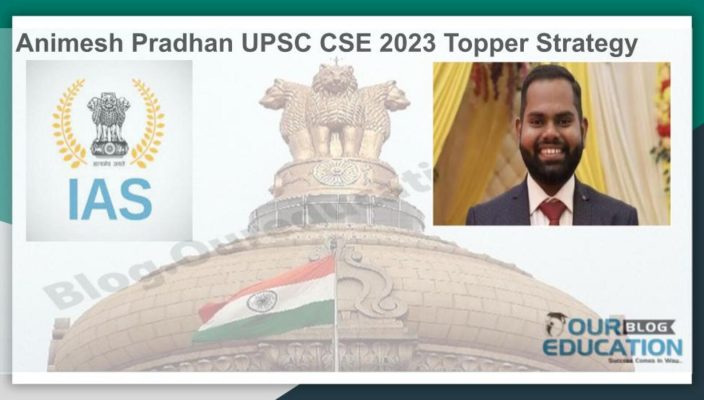
Animesh Pradhan UPSC Topper Strategy: AIR 2 Books, Schedule & Lessons
Last Updated: May 12, 2026
The Animesh Pradhan UPSC topper strategy is one of the most discussed case studies in recent Civil Services preparation circles. Animesh secured All India Rank 2 in the UPSC Civil Services Examination, and his approach reveals a clear, disciplined framework that any sincere aspirant can adapt. Therefore, his journey deserves careful study by anyone aiming for a top rank.

This guide unpacks his daily schedule, optional choice, mains preparation, and interview approach. As a result, you will see exactly which parts of his strategy you can apply to your own preparation.
Background and the Path to AIR 2
Animesh Pradhan comes from Odisha and is an engineering graduate. He cleared UPSC at a remarkably young age, which underlines how a tightly focused first attempt can deliver if the preparation framework is right. Moreover, his story dismantles the myth that long preparation years are essential — disciplined twelve to eighteen months can be enough.
For aspirants exploring the exam from scratch, the official UPSC website is the authoritative source for the latest syllabus, notification, and pattern. Bookmark it and revisit it each cycle.
Optional Subject Choice and Reasoning
Animesh chose an optional that he felt deeply comfortable with rather than chasing a “popular” choice. Specifically, the rule he followed was simple: pick the subject whose syllabus you can revise three times before mains, whose previous-year papers feel approachable, and where quality coaching or notes are easily available. As a result, his optional became a scoring engine rather than a stress point.
Furthermore, browse our UPSC strategy archive for comparative reviews of different optionals before making your own choice.
Daily Study Schedule
The Animesh Pradhan UPSC topper strategy emphasised quality hours over total hours. Specifically, he studied for 8 to 10 hours per day during the final months. However, the structure of those hours mattered more than the count. His typical day included:
- Morning block: Static GS topics with NCERTs and standard references.
- Mid-day: Current affairs reading and structured note-making.
- Afternoon: Optional subject preparation or mains answer writing.
- Evening: Mock-test analysis and revision of weak topics.
Moreover, he kept Sundays for full-week revision rather than new content. Consequently, his mind ended each week with consolidation rather than exhaustion.
Prelims Strategy
For Prelims, Animesh relied on a tight resource list and multiple revisions. Specifically:
- NCERTs from Class 6 to 12 covering History, Geography, Polity, Economy, and Science.
- Laxmikanth for Indian Polity.
- Spectrum’s Brief History of Modern India.
- Ramesh Singh for Indian Economy.
- Shankar IAS Environment.
- Monthly current affairs from a single trusted compilation plus a daily newspaper.
In addition, he attempted at least 50 prelims-style mocks before the exam. Importantly, he spent more time analysing mocks than attempting new ones. As a result, his score consistently stayed above the cutoff with a comfortable margin.
Mains Answer-Writing Approach
Mains is where the Animesh Pradhan UPSC topper strategy truly differentiated him. He began answer writing early in the cycle, treated it as a daily non-negotiable habit, and built a fixed structure for every answer:
- Introduction: One or two sentences framing the question.
- Body: Three to five subheadings with concrete examples.
- Conclusion: Forward-looking observation or policy suggestion.
Moreover, he incorporated recent examples from government schemes, Supreme Court judgments, and Niti Aayog reports. For high-quality policy references, the NITI Aayog official site is an authoritative resource that consistently produces material useful for mains.
Essay and Ethics — Underrated Score Boosters
Animesh treated the Essay paper as a separate focused track. Specifically, he practised one full essay every week, alternated philosophical and factual topics, and built a personal bank of quotes, anecdotes, and case studies grouped by theme. Consequently, his Essay score added a meaningful buffer to his final rank.
For Ethics (GS Paper 4), he combined theory with case-study practice using a fixed framework: stakeholders, ethical dilemmas, options, recommendation. Furthermore, he illustrated theory answers with Indian examples drawn from administration, judiciary, and public life.
Interview Preparation
The interview score for AIR 2 was strong. Animesh credits this to honest self-introspection rather than rote answers. Specifically:
- He prepared a detailed Detailed Application Form (DAF) breakdown.
- He practised mock interviews with multiple panels.
- He stayed calm and acknowledged knowledge gaps gracefully.
Therefore, his personality scored well across confidence, clarity, and integrity — exactly the qualities the board explicitly looks for. For more on the interview stage, see the official UPSC Civil Services Examination page.
Lessons for Young Aspirants
Several elements of Animesh’s journey translate directly for young aspirants:
- Start strong but stay sustainable: Set a 8 to 10 hour daily target rather than 14 to 16.
- Limited sources, multiple revisions: Resist the urge to keep collecting new books.
- Mock analysis over mock count: Spend twice as much time analysing each mock as attempting it.
- Treat optional as a scoring engine: Pick something you genuinely enjoy revising.
- Sleep and recover: Cognitive recall depends on rest.
Therefore, if you are early in your preparation, frontload these habits rather than chasing total hours. As a result, the marathon stays manageable.
Books and Sources He Recommended
Across interviews, Animesh has emphasised the standard list — NCERTs, Laxmikanth, Spectrum, Ramesh Singh, Shankar Environment, PIB, and a daily newspaper. Moreover, he stressed revising the same source four or five times rather than collecting new books late in the cycle. As a result, his mental recall during the exam was sharp and confident.
Common Themes Across the Animesh Pradhan UPSC Topper Strategy
A few themes run through his entire approach:
- Limited sources with multiple revisions.
- Daily answer writing started early in the cycle.
- Mock-test analysis over mock-test count.
- Sustainable schedule with proper sleep.
- Honest self-assessment and willingness to course-correct.
Consequently, his preparation transformed from scattered effort into a tight feedback loop. That is the engine behind any top rank.
Key Takeaways from the Animesh Pradhan UPSC Topper Strategy
To summarise, the Animesh Pradhan UPSC topper strategy rests on disciplined hours, limited but high-quality sources, daily mains answer writing, deep mock analysis, and emotional resilience. Above all, his journey proves that focused preparation in twelve to eighteen months is enough to break into the top ranks.
For more topper journeys and the latest exam coverage, explore the UPSC category on the blog. We wish every aspirant focused preparation and a strong final rank.

Discover more from Our Education | Best Coaching Institutes Colleges Rank
Subscribe to get the latest posts sent to your email.
« Which coaching is best Drishti IAS or Vajiram & Ravi IAS for preparation Donuru Ananya Reddy UPSC Topper Strategy: AIR 3 Books, Schedule & Lessons »
Tell us Your Queries, Suggestions and Feedback