

BITS Pilani converts factory smoke into cooking fuel using
Last Updated: Aug 14, 2026
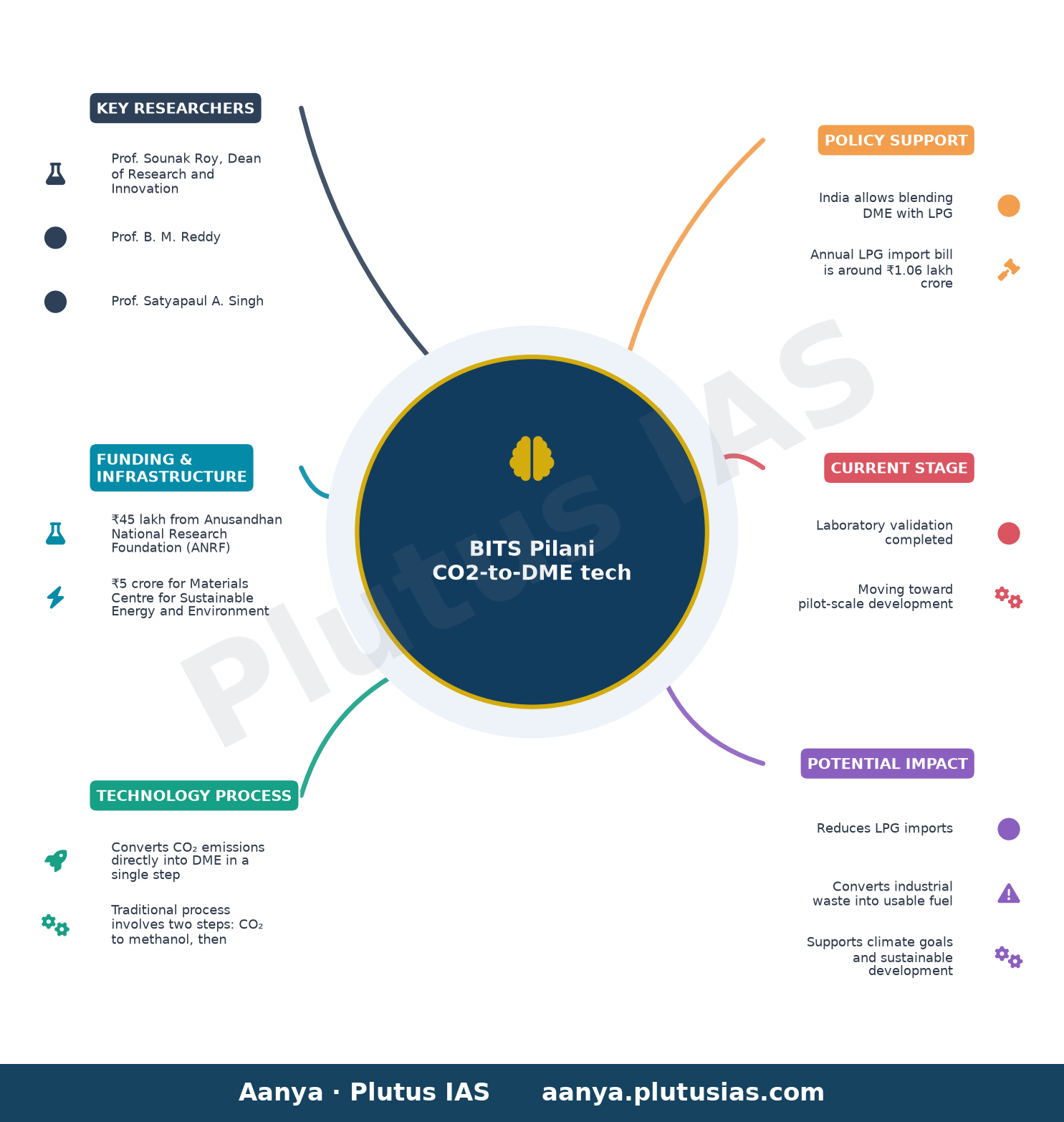
A research team at BITS Pilani has developed a catalyst that converts factory emissions into dimethyl ether (DME), a clean-burning fuel that can supplement LPG for cooking in Indian homes. The technology, validated in the lab, is now moving toward pilot-scale development.
| Funding Source | Amount | Facility Cost |
|---|---|---|
| Anusandhan National Research Foundation (ANRF) | ₹45 lakh | ₹5 crore |
Why Factory Smoke Matters for Indian Kitchens
The BITS Pilani team’s breakthrough addresses a critical challenge: India’s reliance on imported LPG. The country imports a significant portion of its LPG, with an annual import bill estimated at around ₹1.06 lakh crore. Converting industrial CO₂ emissions into DME could reduce this dependence by creating a domestic source of clean cooking fuel.
The research aligns with India’s existing policy framework, which already allows blending DME with LPG. This creates a potential pathway for the technology’s adoption in households across the country.
From CO₂ to Cooking Fuel: The Science Behind the Breakthrough
Traditional DME Production
Traditional methods of producing dimethyl ether (DME) involve a two-step process. First, carbon dioxide (CO₂) is converted into methanol. In the second step, methanol is converted into DME. This multi-step approach is energy-intensive and costly.
The BITS Pilani Innovation
The research team at BITS Pilani simplified this process by developing a catalyst capable of converting CO₂ emissions directly into DME in a single step. This innovation reduces energy consumption, lowers costs, and makes the technology more scalable for industrial applications.
The catalyst was developed and tested over five years by a team of professors, undergraduate, postgraduate, and PhD students at the institute’s Materials Centre for Sustainable Energy and Environment.
The Team Behind the Technology
The project was led by Prof. Sounak Roy, Dean of Research and Innovation, along with Prof. B. M. Reddy and Prof. Satyapaul A. Singh at BITS Pilani’s Hyderabad campus. Over five years, more than 10 students contributed to refining the catalyst, testing reaction conditions, and overcoming engineering challenges.
The research received funding from the Anusandhan National Research Foundation (ANRF) and was conducted at a facility developed at a cost of around ₹5 crore.
Potential Impact on Energy Security and Sustainability
Reducing LPG Imports
India’s annual LPG import bill of around ₹1.06 lakh crore highlights the economic burden of relying on imported fuel. The BITS Pilani technology offers a potential solution by converting industrial waste CO₂ into a usable fuel. This could reduce the country’s dependence on imports and enhance energy security.
Environmental Benefits
By capturing and converting CO₂ emissions from power plants, steel factories, and cement industries, the technology provides a dual benefit. It reduces greenhouse gas emissions while producing a clean-burning fuel that can supplement LPG. This aligns with India’s climate goals and sustainable development objectives.
Policy Support for DME-LPG Blending
The country’s policy framework already permits blending DME with LPG. This regulatory support creates a clear pathway for the adoption of the BITS Pilani technology in households and industries. The blending ratio and implementation details are subject to further regulatory guidelines.
What’s Next for the Technology?
The BITS Pilani team has completed laboratory validation of the catalyst and is now moving toward pilot-scale development. This phase will involve testing the technology in real-world industrial settings to assess its scalability, efficiency, and economic viability.
The success of the pilot could pave the way for partnerships with industries, policymakers, and energy companies to integrate the technology into existing infrastructure. The goal is to make DME a viable and sustainable alternative to LPG for cooking and other applications.
Lessons from Five Years of Research
The BITS Pilani project demonstrates the power of academic research in addressing real-world challenges. By bringing together professors and students from diverse academic backgrounds, the team developed a solution that could have far-reaching implications for India’s energy sector.
The project also highlights the importance of interdisciplinary collaboration and sustained funding in driving innovation. The support from the Anusandhan National Research Foundation (ANRF) and the institute’s investment in infrastructure were critical to the project’s success.
How This Could Change Everyday Life in India
If successfully scaled, the BITS Pilani technology could transform the way India cooks its meals. Instead of relying solely on imported LPG, households could use DME derived from industrial emissions. This would not only reduce the economic burden of fuel imports but also contribute to cleaner air and a more sustainable future.
The technology could also create new opportunities for industries to monetize their waste emissions, turning a liability into an asset. This shift aligns with the principles of a circular economy, where waste is minimized, and resources are reused.
Challenges and the Road Ahead
While the technology holds immense promise, several challenges remain. Scaling up from the lab to industrial applications requires significant investment, infrastructure, and regulatory approvals. The pilot phase will be critical in addressing these challenges and demonstrating the technology’s feasibility.
Additionally, public awareness and acceptance of DME as a cooking fuel will play a key role in its adoption. Educating consumers about the benefits of DME and ensuring its safe and efficient use will be essential for widespread acceptance.
Conclusion: A Step Toward a Greener, More Self-Reliant India
The BITS Pilani research team has taken a significant step toward solving two of India’s most pressing challenges: reducing LPG imports and mitigating climate change. By converting factory smoke into cooking fuel, the technology offers a sustainable solution that could benefit households, industries, and the environment.
As the team moves toward pilot-scale development, the potential of this innovation to transform India’s energy landscape becomes clearer. With continued support from academia, industry, and policymakers, the dream of turning factory emissions into a household necessity could soon become a reality.
Source: the official website of the conducting body — confirm every detail there before acting.
2026-08-13 — always confirm every detail on the official website of the conducting body before acting.
Related updates on OurEducation
- UPSC NDA & NA (I): Exam Date, Notification & Latest Update
- Best IAS Coaching in Kalna
- AFCAT Admit Card 2026 released today
- BITSAT 2026 iteration 4 result released at bitspilaniedu.com: Direct link to download here
- Best IAS Coaching in Visnagar
Discover more from Our Education | Best Coaching Institutes Colleges Rank
Subscribe to get the latest posts sent to your email.
« MP Board Date Sheet 2027: 12वीं परीक्षा 17 फरवरी से, 10वीं UPSC Indian Forest Service (IFoS): Exam Date, Notification & Latest Update »
Tell us Your Queries, Suggestions and Feedback