
Horizontal and vertical angle measurements in field by using Theodolite.
Last Updated: Apr 5, 2017
Measurement of horizontal and vertical angles in the field by using Theodolite.
What is Theodolite ?
Theodolite questions and answers
A Theodolite is a measuring instrument used to measure the horizontal and vertical angles. Theodolite is more precise than magnetic compass. Magnetic compass measures the angle up to as accuracy of 30’. Anyhow a vernier theodolite measures the angles up to and accuracy of 10’’, 20”. It is of either transit or non-transit type. In Transit theodolites the telescope can rotate in a complete circle in the vertical plane while Non-transit theodolites are those in which the telescope can rotate only in a semicircle in the vertical plane.
 Click on Whatapp logo to join oureducation IIT group with many students

TYPES OF THEODOLITES
Types of Theodolites (Construction)
1. Optical-Mechanical Theodolites
Types of Theodolites (Accuracy)
1. Construction Theodolite (1’)
2. Take-ometry (1”)
3. Precise Theodolite (0.2”)
Uses of Theodolite
Mapping the applications and also in construction industry
Measurement of the Horizontal and vertical angle
Measurement of the-magnetic bearing of lines
Locating points on the line
Prolonging the survey lines
Aligning tunnels
Mining works etc
Determining difference in elevation
Setting out curves
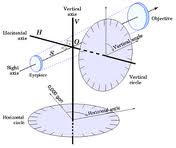
AXES OF THEODOLITES
V – Vertical axis
S – Sight axis, collimation axis
H – Horizontal axis (telescope rotary axis)
L – Level axis (the alidade axis)
SETTING UP THE THEODOLITES
This is carried out in three stages:
1. Centering the theodolites
2. Level-ling the theodolites
3. Removal of parallax.
These procedure would be recommended where it is assumed that the theodolite has to be centered over a nail in the top of a peg. It is a typical point or reference mark used in the construction and setting out.
Tripod must be kept head to level when changing its position. When it has been centered in this way, its legs are pushed firmly into the ground. If one foot goes in more than the others making its head go off level, this can be allowed for by loosening the clamp of the tripod leg affected, adjusting the length and then re-clamping. The theodolite is then taken out of its case, its exact position is then noted to help in replacement, and it is securely attached to the tripod head. Whenever theodolite is to be carried, hold it by the standards and not the telescope. Never let go of the theodolite until it is firmly screwed onto the tripod
The tripod is first set up over the peg. Its legs are placed an equal distance from the peg and are increased to suit the height of the observer. The tripod head must be made as level as possible by eye. Standing back a few paces from the tripod, the center of the tripod head is checked to see if it is vertically above the peg – this should be done by eye from two directions at right angles
ANGLE MEASUREMENT PROCEDURE
Horizontal angle
These angle are used to determine the bearings and directions in control surveys,
for locating detail when mapping and for setting out all types of structure.
Vertical angle
These angles are used to determine the heights of points and to calculate slope corrections
Measurement of horizontal angle
Measurement of Angle ABC
1 The instrument is to be set over B.
2 Lower clamp is then kept fixed and upper clamp is loosened.
3 Telescope is then turned clockwise and vernier A is set to 0° and vernier B to approximately 180 degree
4 The Upper clamp is then tightened and then by using the upper tangent screw, vernier A and B are exactly set to 0° and 180°.
5 The Upper clamp is then tightly fixed and the lower one is loosened and telescope is directed towards A and bisect the ranging rod at A.
6 The lower clamp is tightened and the lower tangent screw is turned to perfectly bisect ranging rod at A.
7 The upper clamp is loosed and the telescope is turned clockwise to bisect the ranging rod at C which is tightened at the the upper clamp and adjustment is being done.
8 Finally the reading on vernier A and B are noted. Vernier A results in the angle directly and vernier B results with the reading by subtracting the initial reading (180°) from final reading.
Vertical angle measurement
- The theodolite is first set up at o. it is then centered and level-led properly. The zeroes of the verniers are set at the 0 deg -0 deg mark of the vertical circle. The telescope is then clamped.
- Then plate bubble are brought to the center with the help of a foot screws and then the altitude bubble is brought to the center by clip screw. At this position the line of the collimation is exactly horizontal.
- The telescope is raised slowly to bisect the point A accurately V to measure the angle of elevation. Finally readings on both the verniers are noted, and the angle of elevation is recorded.
- The face of the instrument is changed and the point A is once again bisected. The verniers readings are noted. The mean of the angles of the observed is assumed to be correct angle of elevation.
- The telescope is lowered slowly and the point B is bisected to measure the angle of depression. Verniers readings are noted for the two observations (face left and right). The mean angle of observation is taken to be the correct angle of depression.
Sources of errors in theodolite
Errors in the equipment :
Horizontal collimation error
This error might occur when the line of sight is not perpendicular to the tilting axis and is detected by taking face left and face right horizontal circle readings to the same point – if these do not differ by exactly 180°, the theodolite has a horizontal collimation error.
The line of collimation of an optical or laser plummet must coincide with the vertical axis of the theodolite. Tests should be carried out on site to check
Field or on site errors:
Instrument not level-led properly
If a theodolite is failed to level properly then it may cause the vertical axis to be tilted adding if the instrument is not levelled properly then error will occur in measured angles which is tough to be eliminated by observing on face left and face right.
Field or on site errors: ground and weather conditions
1. Setting the instrument up on soft ground must be avoided.
2. The instrument must be shade when working in hot sunshine.
3. If refraction is a problem reading must not be taken
4. Instrument must be left to adjust to atmospheric conditions
5. Observations and setting out angles must not be taken in windy conditions.
Discover more from Our Education | Best Coaching Institutes Colleges Rank
Subscribe to get the latest posts sent to your email.
Tell us Your Queries, Suggestions and Feedback
68 Responses to Horizontal and vertical angle measurements in field by using Theodolite.
« Top IES coaching centers in Bangalore Sample Paper for IBPS Exam for Banking Jobs »
narm
narm
narm
UNDERGRADUATE STUDENT @AAU EIABC
UNDERGRADUATE STUDENT @AAU EIABC
UNDERGRADUATE STUDENT @AAU EIABC
nice practice
survey module notes
Irrigation engineering
tumba college of technology
tumba college of technology
tumba college of technology
calculation of area reading with the help of theodolite
what is moment
what is moment
i am a student pursuing btech with the specialization in civil engineering. i want to know how to calculete the correct angle by the vernier scale and main scale in theodolite.
i am a student pursuing btech with the specialization in civil engineering. i want to know how to calculete the correct angle by the vernier scale and main scale in theodolite.
i am a student pursuing btech with the specialization in civil engineering. i want to know how to calculete the correct angle by the vernier scale and main scale in theodolite.
Dip.in Eng