
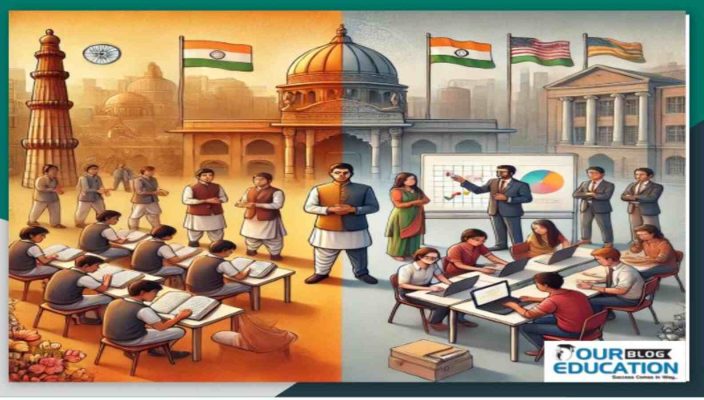
Indian v/s foreign Education
Last Updated: Mar 8, 2025
India v/s Foreign Education: A comparative Analysis
Education is the foundation of a nation’s progress and development. While India has a long and rich history of education, the foreign education system is often considered more practical and advanced. In this article, we will explore the comparison of India v/s Foreign education.
Education -:
| Students | Foreign Education | Indian education |
| Value of work experience | Pratical | Academic results are most important |
| Salary | New ideas and Challenges at every step | Low starting salary |
Indian Education Quantity/Quality
Description 1:According to a recent survey of the world. It is examined that foreign students are most pratical in there academics life, while students of india only concentrate on the degree and marks obtained during academics. It is well known that students of indian society have much more talent than foreigners. Education builds the man, so it builds the nation. Today, India is the biggest human resource supplier to the world, but what is the quality of the human capital, and it is for whose needs? Statistics show that 58% of the employable population was unemployed in India in the year 2004-05.
From Consumers to Producers: India Needs to Skills Workforce
Description 2: What is the cause of such high unemployment in India? India aspires to be a developed and a powerful nation, it wants to play a role in the international community, for that to happen, its economy has to grow multifold and for that to happen, it requires a huge force of entrepreneurs who could transform it into a nation which produces, from the one which only consumes. It needs a huge force of innovators who could make it self-reliant in all kinds of sciences and technologies. India needs artists who could make its culture the most popular in the world. A culture which is not only saleable itself but also helps in selling India’s products across the world. In a nutshell, the country needs Henry Fords, Bill Gateses, Thomas Alva Edisons, and Michael Jacksons born and educated in India. Thus, we can say India has a much intelligent crowd than Foreign students.
Salary India/ Foreign
Description 3: Here in indian education after the degree achieved one can get job over here. but salary expectation in india i can say is comparetive most unsual thing. The life cycle of India runs somewhat low budget, but when we talk about Foreign, it shows the high profile. The increment in Foreign country as compare to india is much high.it gives an increase of 40% every year. while in India it gives only 20%.We are proud to be indian and we must improve our education.
Salary Expectations in India/Foreign
Once a student finishes a degree in India, it is easier to get employed, but expectations of salary continue to be an issue. Salaries in India are lower in terms of the cost of living, but in Indian firms, they are also relatively lower compared to foreign nations.
Foreign Countries: The salary increments are greater with an average rate of increase every year of approximately 40%.
India: Salary increments are smaller, with an average rate of about 20% every year.
This pay difference hits most Indian graduates who dream of working overseas in order to get better pay and career development. Foreign nations have a better way of life and improved professional prospects, which makes them a favorable option for Indian students
Unemployment Crisis in India
One of the key problems bothering India’s education sector is the rampant unemployment rate. Even though India graduates millions of students each year, it lags behind in creating jobs and skill-based employment. Various reasons are responsible for this issue:
Shortage of Entrepreneurial Culture: India lacks entrepreneurs who can stimulate economic growth as opposed to mere job seekers.
Limited Innovation: Insufficient focus on research and development is the main drawback in India’s development in science and technology.
Cultural Influence: Indian education tends to favor traditional professions such as engineering and medicine over business and creative-oriented careers.
Conclusion:
India has a highly intelligent and talented population. By making necessary changes in the education system, India can transform its workforce into a global powerhouse. The ultimate goal should not only be academic excellence but also creating individuals who can contribute to society in meaningful ways.
Follow blogoureducation channel on WhatsApp
To get the latest updates, connect with our education YouTube channel

Discover more from Our Education | Best Coaching Institutes Colleges Rank
Subscribe to get the latest posts sent to your email.
« Best 10 GRE Coaching in Delhi Education in India – Burden Or Opportunity? »
Tell us Your Queries, Suggestions and Feedback