
73% students drop out before higher secondary
Last Updated: Aug 13, 2026
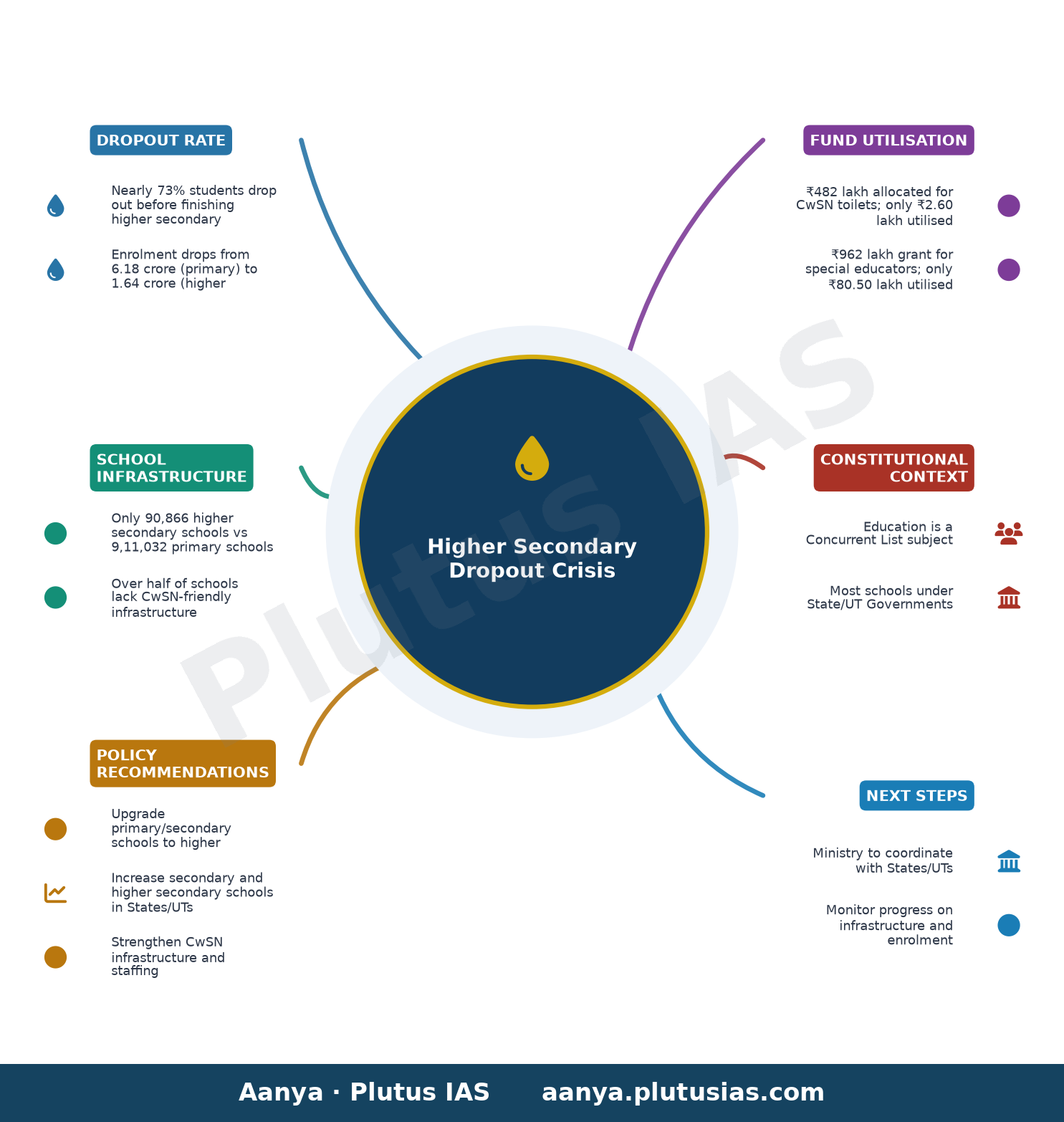
Nearly 73% of Indian students drop out before completing higher secondary, a parliamentary panel warned on August 12, 2026, highlighting a drastic decline in schools and enrolment as education levels rise.
| Education Level | Number of Schools | Number of Students Enrolled |
|---|---|---|
| Primary | 9,11,032 | 6,18,45,033 |
| Upper Primary | 4,12,805 | 4,08,93,978 |
| Secondary | 1,61,808 | 2,36,68,220 |
| Higher Secondary | 90,866 | 1,64,17,949 |
Why the drastic decline in higher secondary education?
The parliamentary panel’s Tenth Report (Eighteenth Lok Sabha) for 2026-27 reveals a sharp contraction in both school infrastructure and student enrolment as students progress from primary to higher secondary levels. While there are over 10 lakh schools across India, the vast majority are concentrated at the primary level. Only 90,866 schools exist at the higher secondary stage, compared to 1.6 lakh at the secondary level and 4.1 lakh at the upper primary level. This structural imbalance creates physical inaccessibility for students seeking to complete higher secondary education.
Enrolment collapse mirrors school scarcity
Student numbers mirror the school distribution pattern. From 6.18 crore students in primary classes, enrolment drops to 4.08 crore in upper primary, then to 2.36 crore in secondary, and further to 1.64 crore in higher secondary. The panel notes that this translates to a dropout rate of nearly 73% before students finish higher secondary, indicating systemic barriers in access, infrastructure, and continuity.
Urgent call to upgrade schools and expand higher secondary access
The committee has strongly urged the Ministry of Education to prioritise upgrading existing primary and secondary schools into full higher secondary schools. This recommendation aims to ensure that a high school is physically accessible to students across different communities and to arrest the alarming student drop-off rate. The panel emphasized that education is a Concurrent List subject, with most schools under State and Union Territory administrations, and called on the Ministry to impress upon all State/UT Governments to establish more secondary and higher secondary schools to boost enrolment.
Inclusive education for Divyang students remains severely underprovided
The panel flagged a critical gap in infrastructure for Children with Special Needs (CwSN). Despite constitutional provisions and the Samagra Shiksha scheme’s financial support, over half of India’s schools lack CwSN-friendly infrastructure. As per UDISE+ 2024-25 data, only 5,23,143 out of 14,71,437 schools have CwSN the medialets, and only 8,08,466 schools have ramps with handrails. The committee observed that during 2024-25, only ₹2.60 lakh was utilised out of a ₹482 lakh allocation for constructing 186 CwSN the medialets, with no progress in physical targets.
Financial underutilisation and staffing gaps
The panel also highlighted underutilisation of funds for new special educators. Only ₹80.50 lakh was utilised against a budgetary grant of ₹962 lakh for the elementary section, indicating poor progress in recruiting and retaining special educators for CwSN students. Despite the Ministry’s rights-based, inclusive, and holistic approach to education for Divyang children, the committee stressed the need for accelerated implementation and monitoring to ensure tangible outcomes.
Policy gaps and constitutional realities
The committee acknowledged that education is placed in the Concurrent List of the Constitution, with most schools managed by State Governments and Union Territory Administrations. This decentralised structure necessitates coordinated action between the Centre and States to expand secondary and higher secondary infrastructure. The panel recommended that the Ministry impress upon all State/UT Governments to prioritise the setting up of more secondary and higher secondary schools to increase student enrolment and reduce dropout rates.
Key recommendations from the parliamentary panel
- Upgrade existing primary and secondary schools into full higher secondary schools to improve physical access.
- Increase the number of secondary and higher secondary schools across States and UTs to address enrolment decline.
- Strengthen CwSN-friendly infrastructure, including the medialets, ramps, and accessible pathways, with strict monitoring of fund utilisation.
- Enhance recruitment and retention of special educators for CwSN students under the Samagra Shiksha scheme.
- Ensure timely utilisation of allocated budgets for infrastructure and human resources to meet physical targets.
How to check and apply for school-related schemes
- Identify relevant schemes: Check the official website of the conducting body for schemes under Samagra Shiksha or other education initiatives.
- Verify eligibility: Review the eligibility criteria for upgrading schools or availing infrastructure support for CwSN students.
- Contact State/UT Education Departments: Since education is a State subject, approach the State or UT education department for local implementation of central schemes.
- Submit applications: Follow the application process outlined on the official website or through designated government portals.
- Monitor progress: Track the status of applications and infrastructure development through official updates from the conducting body.
What students and parents can do
For students and parents concerned about access to higher secondary education, the panel’s report underscores the importance of advocating for school upgrades and infrastructure improvements in your locality. Contact your local education department or school authorities to inquire about ongoing or planned upgrades. Additionally, support initiatives that promote inclusive education for Divyang students by reporting gaps in infrastructure to the relevant authorities.
Future outlook and next steps
The parliamentary panel’s report serves as a critical call to action for policymakers, educators, and civil society. The Ministry of Education is expected to work closely with State and UT Governments to implement the recommendations, expand infrastructure, and ensure inclusive access to higher secondary education. However, the pace of progress will depend on coordinated efforts, adequate funding, and strict monitoring of physical and financial targets.
Source: the official website of the conducting body — confirm every detail there before acting.
2026-08-13 — always confirm every detail on the official website of the conducting body before acting.
Related updates on OurEducation
- UPSC CAPF (AC): Exam Date, Notification & Latest Update
- 73% Indian students drop out before higher secondary
- UPSC CSE Mains Countdown: Current Affairs Integration and Value Addition Strategy
- UPSC CSE Mains GS Paper 2: Polity, Governance and International Relations Strategy
- UPSC CSE Mains GS Paper 2 Strategy — Polity, Governance, Social Justice & IR Complete
Discover more from Our Education | Best Coaching Institutes Colleges Rank
Subscribe to get the latest posts sent to your email.
« SSC MTS: Exam Date, Notification & Latest Update UPSC Engineering Services (ESE/IES): Exam Date, Notification & Latest Update »
Tell us Your Queries, Suggestions and Feedback