
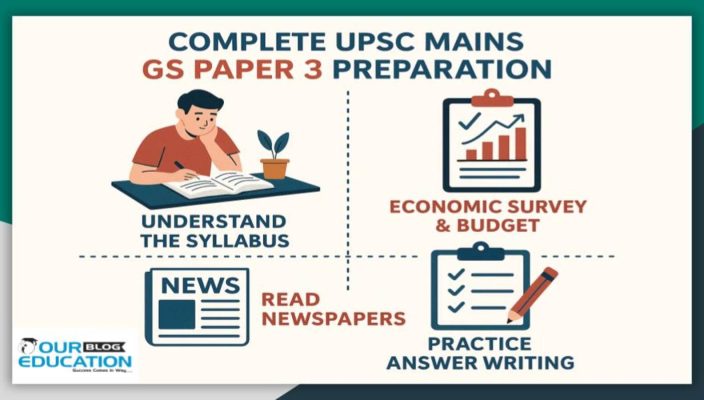
Complete UPSC Mains GS Paper 3 Preparation Strategy 2026: Topics, Books & Test Series
Last Updated: May 6, 2026
Updated for UPSC CSE 2026: The General Studies Paper 3 of the UPSC Civil Services Mains examination is widely regarded as the most dynamic and analytical paper of the entire Mains stage. It tests the candidate’s understanding of the Indian economy, agriculture, science and technology, environmental issues, internal security, and disaster management, all subjects that change rapidly with each passing year. With UPSC CSE Mains 2026 scheduled for August 2026, this guide gives you a complete, current strategy to master GS Paper 3.
UPSC GS Paper 3: Syllabus Snapshot (2026)
GS Paper 3 carries 250 marks and runs for 3 hours. The official syllabus covers six broad themes:
- Indian Economy, planning, mobilization of resources, growth, development, employment, inclusive growth, government Budget.
- Agriculture, major crops, cropping patterns, irrigation, agricultural marketing, e-technology, MSP, PDS, food processing.
- Science & Technology, developments and applications, indigenisation, IT, space, biotech, nano, IPR.
- Environment & Biodiversity, conservation, EIA, climate change, pollution.
- Disaster Management, types, preparedness, NDMA framework.
- Internal Security, extremism, cyber-security, money laundering, border management, agencies and forces.
Why GS Paper 3 Decides Mains Rank in 2026
Topper interviews from CSE 2024 and CSE 2025 show a clear trend, candidates with strong GS3 scores are consistently breaking into the top 100. The paper rewards current-affairs-anchored analytical writing rather than rote learning. The Union Budget 2026-27, the latest Economic Survey, and the rapid pace of climate and security developments mean static notes alone are no longer enough.
Section-Wise Strategy for GS Paper 3
1. Indian Economy & Agriculture (≈100 marks)
This is the highest-scoring half of the paper. Build your base from Indian Economy by Ramesh Singh or Sanjeev Verma, then layer current data on top:
- Read the Economic Survey 2025-26 and Union Budget 2026-27 cover-to-cover. Make a 30-page notes document focusing on key allocations, schemes, and growth indicators.
- Track key indicators monthly, GDP growth, CPI/WPI inflation, fiscal deficit, unemployment (PLFS), CAD, FDI inflows.
- For agriculture, focus on PM-KISAN, PMFBY, PM-AASHA, e-NAM, PM-KMY, MSP recommendations, and the latest NITI Aayog reports on agri-marketing reforms.
- Schemes to memorize for 2026: PM Kisan Samman Nidhi, Pradhan Mantri Fasal Bima Yojana, PM Gati Shakti, PLI Scheme expansions, and Digital Agriculture Mission.
2. Science & Technology (≈30-40 marks)
Build static knowledge from NCERT (VI–X) and one standard book, then track current developments:
- Space: Chandrayaan-4 mission updates, Gaganyaan crewed mission timeline, Bharatiya Antariksh Station (BAS) roadmap, ISRO–NASA NISAR collaboration.
- Defence tech: Indigenous Tejas Mk1A induction, Project-75I submarines, AMCA programme, Agni-Prime tests.
- AI & Quantum: India AI Mission allocation, National Quantum Mission progress, IndiaAI Compute Portal.
- Biotech & Health: BioE3 Policy, indigenous mRNA platforms, AYUSH integration in primary healthcare.
3. Environment, Disaster Management & Biodiversity (≈40-50 marks)
This is where the highest variation in marks occurs. UPSC consistently asks application-based questions linking environment with economy and security:
- Track COP30 (Belém, Brazil) outcomes for 2026 mains relevance.
- Master India’s NDC commitments, the LIFE movement, Mission Innovation, Green Hydrogen Mission, and the Panchamrit pledges.
- Disaster Management: NDMA guidelines, Sendai Framework, recent events like Wayanad landslides 2024 and Sikkim GLOF, urban flooding case studies.
- Biodiversity: CITES, Ramsar sites added in 2024-25, Project Tiger 50-year review, Cheetah reintroduction Phase-2.
4. Internal Security (≈40-50 marks)
Use Challenges to Internal Security of India by Ashok Kumar & Vipul Anekant as the core reference. Topics that are likely high-yield in 2026:
- Left-Wing Extremism, current state, SAMADHAN doctrine, surrender-and-rehab schemes.
- Cyber-security, Digital Personal Data Protection Act 2023 implementation, CERT-In directions, National Cyber Security Strategy.
- Money laundering, PMLA amendments, FATF mutual evaluation results.
- Border management, Smart Border Fencing along India-Bangladesh and India-Myanmar, Free Movement Regime review.
- Agencies, NIA, NATGRID, NTRO, CRPF, BSF, ITBP, know mandates and recent operational highlights.
Answer Writing Framework for GS3
Every GS3 question rewards a clear analytical structure. Use the IDC framework, Introduction, Dimensions, Conclusion:
- Introduction (40-50 words): Define the keyword, add a recent data point, and state your thesis.
- Body (Dimensions): Break into 3-5 sub-headings, economic, social, technological, governance, security, environmental, depending on the question.
- Examples: Always use schemes, commission names, court verdicts, or recent news items as evidence.
- Diagrams & flowcharts: A simple labelled diagram saves words and earns marks.
- Conclusion (30-40 words): A forward-looking, solution-oriented closing that ties the answer to SDG, Vision-2047, or a recent policy goal.
Best Books & Sources for GS3 (2026 List)
- Economy: Indian Economy by Ramesh Singh, Sriram’s Economy Notes, Economic Survey 2025-26.
- S&T: NCERTs (VI-X), Vision IAS S&T compilation, PIB releases on ISRO/DRDO.
- Environment: Shankar IAS Environment, MoEFCC reports, Down To Earth.
- Internal Security: Ashok Kumar, Challenges to Internal Security, IDSA monographs.
- Newspapers: The Hindu + Indian Express + PIB, daily.
Test Series & Coaching Recommendations
A high-quality answer-writing test series is non-negotiable for GS3. Top mentors and toppers in 2026 widely recommend the following platforms for serious aspirants:
- Plutus IAS, known for analytical mentorship, especially for economy and internal-security current affairs modules.
- The Hindu Zone, curated newspaper analysis and GS3-specific value-added notes.
- Vision IAS Mains 365 and Insights IAS Secure compilations for daily answer-writing practice.
Look for a programme that gives individual evaluation with structural feedback, generic model answers won’t move your rank.
30-Day Last-Mile Plan (For July 2026)
- Days 1-7: Revise economy + agriculture full notes; write 2 GS3 answers daily.
- Days 8-14: Environment + S&T revision with daily current-affairs map of last 6 months.
- Days 15-21: Internal security + disaster management; attempt 2 full sectional tests.
- Days 22-28: Two complete GS3 mock tests (3-hour, full paper); evaluation; rewrite weak answers.
- Days 29-30: Quick scheme/data revision; rest the day before exam.
Frequently Asked Questions
Q1. How many hours a day are needed for GS Paper 3 preparation?
For an 8-12 month preparation cycle, approximately 2-3 hours daily dedicated to GS3 (alongside other GS papers and optional) is sufficient. In the last 90 days before Mains, this should rise to 4-5 hours including answer writing.
Q2. Is the Economic Survey enough for the economy section of GS3?
The Economic Survey is necessary but not sufficient. It must be combined with a static text (Ramesh Singh or Sanjeev Verma), the latest Union Budget, and monthly current-affairs tracking.
Q3. Which is the best book for internal security in UPSC GS3?
Challenges to Internal Security of India by Ashok Kumar and Vipul Anekant is widely considered the most comprehensive single-source book for this section.
Q4. How important is current affairs for GS Paper 3?
Extremely important, almost 60-70% of GS3 questions are anchored to events of the previous 12-18 months. Daily newspaper reading and a monthly compilation are essential.
Q5. Should I take a separate test series for GS3?
Yes, a dedicated test series with at least 8-10 GS3 sectional tests and 4-5 full mocks dramatically improves writing speed, structure, and content recall under pressure.
Final Word
UPSC GS Paper 3 rewards candidates who treat it as a living paper, one that absorbs the day’s headlines into a clean analytical framework. Build a strong static base, layer current affairs religiously, write at least 4-5 answers a week, and you will see tangible improvement well before Mains 2026. Stay consistent, evaluate your weak themes every 30 days, and trust the process.
For more UPSC strategy guides and topper interviews, explore the IAS Preparation section on this blog.

Discover more from Our Education | Best Coaching Institutes Colleges Rank
Subscribe to get the latest posts sent to your email.
« What are the tips and tricks to write faster and neater in Mains exam of UPSC? What is the Impact of One-on-One Mentorship by the Top IAS preparation institute in Delhi? »
Tell us Your Queries, Suggestions and Feedback