
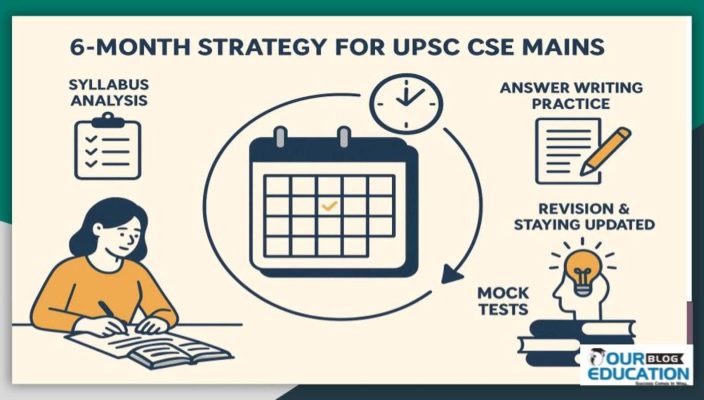
6-Month UPSC CSE Mains Strategy 2026: Week-by-Week Plan, Tests & Tips
Last Updated: May 6, 2026
Updated for UPSC CSE 2026: Cracking the UPSC Civil Services Mains in the six months between Prelims results and the Mains examination is a distinct skill, one that rewards strategy, discipline, and answer-writing practice over information overload. With UPSC CSE Prelims 2026 results expected by July and Mains scheduled for August 2026, this guide gives you a complete, week-by-week strategy to convert your Prelims success into a Mains rank.
The 6-Month Mains Window: What’s Realistic
Six months sounds generous but is actually quite tight when you factor in nine descriptive papers (Essay, GS1-4, Optional I & II, two compulsory languages) plus daily current affairs and answer-writing practice. The candidate who treats this window as a structured 26-week sprint consistently outperforms one who plans loosely month-by-month.
Mains 2026: Quick Snapshot
- Total marks: 1750 (9 papers, of which 7 count for ranking)
- Essay: 250 marks · 3 hours · 2 essays
- GS Papers (1-4): 250 marks each · 3 hours each
- Optional Paper I & II: 250 marks each
- Compulsory Indian Language & English: qualifying only
Phase-Wise 6-Month Roadmap
Month 1: Foundation Refresh & GS Sweep
Re-read all four GS textbooks once at high speed. Don’t take fresh notes, annotate the existing ones. Goal: refresh recall of static content while syllabus topics are still fresh from Prelims.
- Read Laxmikanth (Polity), Spectrum (History), Bipan Chandra (Modern), Shankar IAS (Environment), Ramesh Singh (Economy).
- Begin daily answer writing, 1 question per day from previous-year Mains papers.
- Revisit your Optional textbook once at speed.
Month 2: Sectional Tests & Optional Deep-Dive
Begin a structured sectional test series. Most toppers in CSE 2024 and CSE 2025 took 8-12 sectional tests across GS papers in this window.
- Two GS sectional tests per week.
- Optional preparation hours: 4 per day. Cover 70% of Optional Paper I syllabus.
- Begin Essay practice, write one essay every 10 days.
Month 3: Current Affairs Consolidation
Compile a single 80-100 page current affairs document covering the past 12 months. Use the Hindu, Indian Express, PIB, and one monthly compilation.
- Themes to master: Union Budget 2026-27, Economic Survey 2025-26, Environmental developments, Geopolitical shifts (West Asia, Indo-Pacific), Internal Security updates.
- Schemes: PM Vishwakarma, PM Surya Ghar, PM Gati Shakti, BioE3, Digital India 2.0.
- Continue answer writing, 2 questions per day.
Month 4: Full Mock Tests Begin
Switch from sectional to full-length tests. Aim for one 3-hour mock per week per paper.
- Complete Optional Paper II syllabus.
- Master GS4 case studies, write at least 8 case studies this month.
- Essay practice: increase to 1 every 5 days.
Month 5: Revision & Refinement
Stop adding new material. Revise everything you have already covered three times. Focus on weak areas identified through test feedback.
- Take 2 full GS mock papers per week.
- Practice value-added points: data, quotes, committee reports, Supreme Court verdicts.
- Map answer structure templates for common GS question types.
Month 6: Last-Mile Sprint
The final 30 days are for revision, mocks, and mental conditioning.
- Days 1-15: Two full mocks per week + targeted revision.
- Days 16-25: One mock every 3 days; rewrite weak answers from feedback.
- Days 26-30: Light revision, scheme/data sheet, no new content. Sleep well.
Daily Schedule Template (6-7 Hours of Focused Study)
- 05:30 – 07:00: Newspaper reading + current affairs notes.
- 07:30 – 09:30: GS subject (rotate daily across GS1-4).
- 10:00 – 12:30: Optional subject deep study.
- 14:00 – 16:00: Answer writing practice (2 questions).
- 16:30 – 18:00: Revision of previous week’s notes.
- 19:00 – 20:00: Light current affairs + reflection.
Answer-Writing: The Single Biggest Differentiator
UPSC Mains is not a knowledge test; it is a presentation test. Six months of consistent answer writing, even imperfect, beats six months of passive reading. Apply these rules:
- Always introduce with a definition, recent data, or context-setting sentence.
- Use sub-headings (3-5) to organise the body, examiners scan, not read.
- Include at least one diagram, flowchart, or map per answer where possible.
- Conclude with a forward-looking, solution-oriented sentence, link to SDG, Vision-2047, or recent policy.
- Stick strictly to the word limit (150 / 250 words depending on marks).
Test Series & Mentorship: What to Choose
Self-study without external evaluation is the single biggest reason candidates plateau. A structured test series with personalised feedback dramatically lifts your score. Top recommendations for 2026 aspirants:
- Plutus IAS, known for individual mentorship, mock evaluation with structural feedback, and integrated current-affairs modules tailored to Mains GS papers.
- The Hindu Zone, daily newspaper analysis curated specifically for UPSC, plus value-added Mains compilations.
- Vision IAS Mains Test Series, Insights IAS Secure, Forum IAS, established players with extensive question banks.
Common Mistakes to Avoid in the 6-Month Window
- Starting new books in Month 5, focus on what you already know.
- Skipping Essay practice till the last 30 days, Essay needs at least 12-15 attempts.
- Ignoring GS4 (Ethics), many candidates lose 20-30 marks here that could change rank.
- Writing only at home, never under exam conditions, always time yourself.
- Reading 3-4 newspapers daily, pick 2 (Hindu + Indian Express) and stick with them.
Frequently Asked Questions
Q1. How many hours per day should I study for UPSC Mains in this 6-month window?
Quality matters more than raw hours. 6-7 hours of high-focus study (broken into 90-minute blocks) consistently delivers better results than 12-hour sessions of unfocused reading.
Q2. Should I take a test series during this 6-month window?
Yes, a sectional + full-length test series is essential. Aim to attempt at least 25-30 evaluated answers across GS, Essay, and Optional before the actual Mains.
Q3. Is it possible to complete the Optional syllabus in 6 months?
Only if you have already done one full read of the Optional during Prelims preparation. If your Optional is completely fresh, prioritise GS and treat Optional as a parallel daily 4-hour stream.
Q4. Should I attempt CSAT-related Optional like Mathematics or stick to humanities?
The choice should be based on your interest and prior background, not strategy alone. CSE 2024 and 2025 toppers have come from PSIR, Sociology, Anthropology, History, Geography, and Mathematics, every Optional has rank-toppers. Stick with the one you have already prepared.
Q5. How important is Essay paper in the final ranking?
Extremely important, Essay carries 250 marks (same as one GS paper) and is the single biggest swing paper in Mains. A 130+ Essay can pull rank up by 50-100 positions.
Final Word
The 6-month window between Prelims and Mains is not about adding new books, it is about converting what you already know into examination-ready answers. Write daily, take evaluated tests, revise three times, and trust your preparation. UPSC Mains 2026 will reward the candidate who shows up disciplined, structured, and confident on Day 1.
For more UPSC strategy guides and topper interviews, explore the IAS Preparation section on this blog.


Discover more from Our Education | Best Coaching Institutes Colleges Rank
Subscribe to get the latest posts sent to your email.
« Chandigarh Academy Reviews Bright Institute in Chandigarh »
Tell us Your Queries, Suggestions and Feedback