

Psychology graduates in corporate India
Last Updated: Aug 22, 2026
Psychology graduates in India are now being hired for roles beyond counselling and HR, including strategy planning, behavioural research, and market analysis. The surge in demand has pushed CUET Psychology registrations to 32,875 in 2025, reflecting a growing corporate appetite for behavioural science skills.
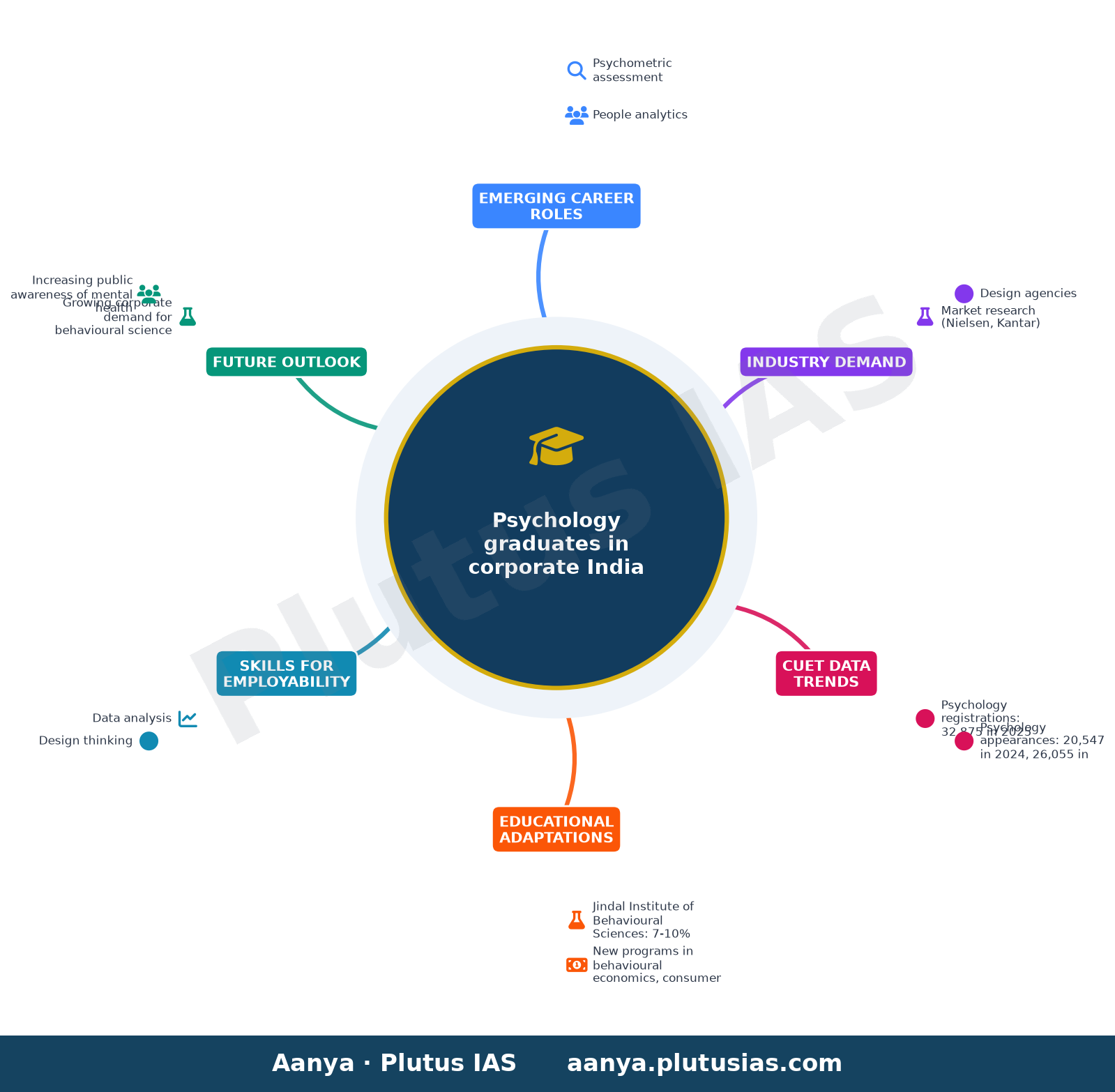
| Metric | 2024 | 2025 |
|---|---|---|
| CUET Psychology registrations | — | 32,875 |
| CUET Psychology appearances | 20,547 | 26,055 |
From clinics to corporations: The evolving career landscape for psychology graduates
Gaurika Gupta’s journey from a master’s program in applied psychology to a strategy planner at a design agency exemplifies a broader shift in the field. Once confined to counselling and academia, psychology graduates are now sought after for roles that leverage behavioural science in corporate settings. Gupta’s work involves dissecting consumer data to identify market “white spaces” and translating behavioural insights into product strategies, a far cry from traditional clinical roles.
The transformation is not isolated. Recruiters from industries as diverse as market research, design, and consulting are actively hiring psychology graduates. Companies like Nielsen, Kantar, and Maven Magnet AI are integrating behavioural science into their operations, creating roles that demand expertise in consumer psychology, employee wellbeing, and organisational development. This shift is reshaping the perception of psychology as a discipline, moving it from a fallback option to a strategic career choice.
A decade of change: How the field has expanded
A decade ago, psychology graduates in India had limited career options, primarily confined to counselling, HR, or academia. However, the emergence of new roles—such as people analytics, psychometric assessment, and behavioural training—has opened up a wealth of opportunities. Educators note that this expansion is driven by a growing recognition among employers that understanding human behaviour is critical to organisational success.
Prof. Pulkit Khanna, Dean of the Jindal Institute of Behavioural Sciences at O.P. Jindal Global University, highlights the increasing demand for psychology graduates. He attributes the trend to three key factors: greater public awareness of psychology, the opening of interdisciplinary career paths, and employers’ growing acknowledgment of the importance of behavioural science in driving revenue and operational efficiency.
The numbers behind the surge: CUET registrations and appearances
The growing interest in psychology is reflected in the CUET registration data. In 2025, Psychology registrations reached 32,875, while the number of students who appeared for the paper increased from 20,547 in 2024 to 26,055 in 2025. This places psychology among the more sought-after elective subjects in the centralised university entrance exam, a stark contrast to its previous status as a fallback choice.
The rise in registrations and appearances suggests a broader trend: students are increasingly viewing psychology as a viable and lucrative career path, rather than a secondary option. This shift is also fuelled by the normalisation of mental health conversations in India, amplified by social media and a generation more open to discussing therapy, anxiety, and burnout.
Corporate demand: Roles and industries hiring psychology graduates
The corporate sector’s growing appetite for psychology graduates is evident in the variety of roles and industries now recruiting from this pool. Companies are hiring for positions such as:
- People analytics and behavioural research
- Psychometric assessment and employee testing
- Behavioural training and organisational development
- Consumer insights and market research
- Employee wellbeing and performance coaching
- User experience (UX) design and strategy planning
Recruiters from established firms like KPMG, Airtel Business, ITC Limited, Vodafone, and Policybazaar are now actively hiring psychology graduates, alongside newer organisations such as Maven Magnet, Thomas Assessment, and Grant Thornton Bharat. These roles go beyond traditional counselling and HR functions, focusing instead on leveraging behavioural science to drive business outcomes.
Why employers are investing in psychology graduates
Employers are recognising that understanding human behaviour is central to running any organisation. Whether it’s designing products that resonate with consumers or creating workplace policies that enhance productivity, psychology graduates bring a unique skill set to the table. Prof. Khanna notes that most organisations today acknowledge that people are at the heart of most processes, and that behavioural change—whether in consumers or employees—requires a deep understanding of human psychology.
This recognition has led to a surge in interdisciplinary collaborations, where psychology intersects with fields like design, marketing, and consulting. For example, a psychology graduate working in a design agency might analyse consumer data to identify unmet needs, while another in a corporate setting might develop training programs to improve employee performance. These roles highlight the versatility of a psychology degree and its relevance in today’s job market.
Educational institutions adapting to the demand
Educational institutions are responding to the growing demand for psychology graduates by expanding their programs and offering specialised courses. The Jindal Institute of Behavioural Sciences, for instance, has seen a 7 to 10% increase in applicants for its master’s courses in Applied Psychology and Psychosocial Rehabilitation since the pandemic. The institute’s limited intake capacity makes this growth particularly notable.
Other institutions are also introducing new programs or modifying existing ones to align with industry needs. Courses in behavioural economics, consumer psychology, and organisational behaviour are becoming more common, reflecting the evolving career landscape for psychology graduates. These programs equip students with the skills needed to thrive in corporate roles, bridging the gap between academia and industry.
How to leverage a psychology degree in today’s job market
- Identify your niche: Psychology graduates should explore roles that align with their interests, whether it’s market research, employee wellbeing, or behavioural training. Identifying a niche early can help tailor your skill set to specific job requirements.
- Develop interdisciplinary skills: Courses in data analysis, design thinking, or business management can complement a psychology degree and make you more competitive in the job market.
- Gain practical experience: Internships and projects in corporate settings can provide hands-on experience and help build a professional network. Look for opportunities in market research firms, design agencies, or HR departments.
- Stay updated on industry trends: Follow developments in behavioural science, organisational psychology, and related fields to stay ahead of the curve. Engage with industry publications, webinars, and networking events.
- Leverage alumni networks: Many educational institutions have strong alumni networks that can provide mentorship and job opportunities. Connect with alumni working in your desired field to gain insights and guidance.
- Highlight transferable skills: When applying for jobs, emphasise skills like critical thinking, problem-solving, and communication, which are valuable in any corporate role. Tailor your resume to highlight how your psychology background addresses specific job requirements.
The future of psychology in India: Opportunities and challenges
The future of psychology in India looks promising, with growing corporate demand and increasing public awareness of mental health. However, challenges remain. The field is still grappling with issues like the lack of standardised career paths, limited awareness among students about non-clinical roles, and the need for more industry-academia collaborations.
Educators and industry experts are optimistic about the field’s growth. As more students recognise the value of a psychology degree in corporate settings, and as employers continue to invest in behavioural science, the discipline is poised to become a mainstream career choice. The key to sustaining this growth will be ensuring that educational programs align with industry needs and that students are equipped with the skills required to succeed in emerging roles.
Key takeaways for aspiring psychology graduates
- Psychology graduates are no longer limited to counselling or HR roles; they are increasingly sought after for corporate positions in behavioural science, market research, and organisational development.
- The surge in CUET Psychology registrations and appearances reflects a growing interest in the field among students.
- Corporate demand for psychology graduates is driven by the need to understand human behaviour in consumer and employee contexts.
- Educational institutions are adapting to the demand by expanding programs and offering specialised courses in behavioural science and related fields.
- Students can leverage their psychology degree by identifying niches, developing interdisciplinary skills, gaining practical experience, and staying updated on industry trends.
Conclusion: A field in transition
The shift in the career landscape for psychology graduates in India marks a significant departure from traditional pathways. As corporate India embraces behavioural science, psychology graduates are finding themselves at the forefront of innovation, driving change in industries ranging from market research to design and consulting. This transition is not just reshaping career opportunities but also redefining the role of psychology in society. For students considering a degree in psychology, the message is clear: the field offers far more than counselling and HR roles—it is a gateway to a dynamic and evolving career in corporate India.
Source: the official website of the conducting body — confirm every detail there before acting.
2026-08-22 — always confirm every detail on the official website of the conducting body before acting.
Related updates on OurEducation
- HPBOSE 12th Final Merit List 2026 Released
- CISCE SHINE 2026 Registration Open
- UPPSC GIC Lecturer Admit Card 2026: Hall Ticket Download Link
- UGC-NET 2026 Answer Key Challenge Fee: ₹200 Refund Rules
- NEET UG Round 1 Seat Allotment Result 2026
Discover more from Our Education | Best Coaching Institutes Colleges Rank
Subscribe to get the latest posts sent to your email.
« UPSC EPFO APFC Recruitment 2026 notification out for 80 posts SSC JE final answer key 2025 released: Download at ssc.gov.in »
Tell us Your Queries, Suggestions and Feedback