
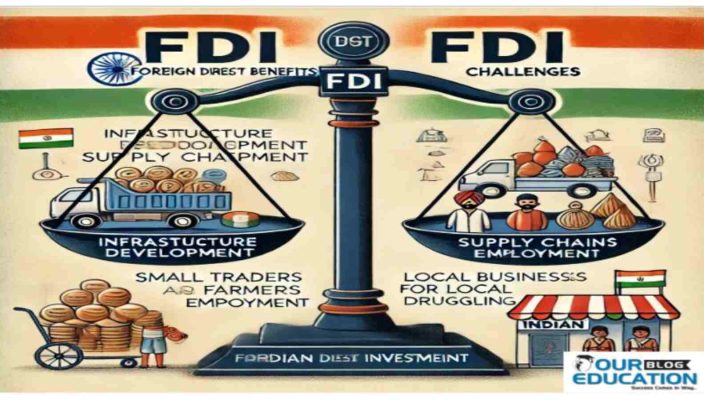
FDI in retail – Boon or bane for India
Last Updated: Mar 6, 2025
FDI in retail – Boon or bane for India
Introduction:
Foreign Direct Investment (FDI) in retail refers to foreign investment in the Indian retail sector, encompassing single-brand and multi-brand retail businesses. Currently, FDI in pure retailing is prohibited under Indian law. However, the government has permitted FDI in retailing specific brands. The recent decision to allow 51% FDI in multi-brand retail has sparked debate, raising questions about whether FDI in retail is a boon or bane for India.
Benfits Of FDI In Retail
Investment in Retail Infrastructure
Now, FDI would allow foreign companies to bring in the necessary investment to upgrade the retail sector infrastructure across the country. Since their focus would be profit, they would set up efficient supply chain management systems to ensure that product deliveries are on time. The emphasis would be on reduction in wastage of food items.
Control Over Food Prices
This would bring down the food prices, which have been a major cause of inflation in the country as well as a source of public dissent against the government. The farmers would get a better price for their produce for two reasons.
Better Prices For Farmers
- It would also lead to the removal of the middlemen, which would provide additional revenue to the farmers (the retail chains would buy directly from the farmers).
- Contractual farming would mean improved and efficient farming practices as well as higher output and better prices.
Employment Generation & Infrastructure Development
It would also generate employment opportunities in the wake of improved supply chains that would be set up to cater to these retail stores. It is mandated in the policy that 50% of any investment over $100 million would be in the backend infrastructure, which would create jobs as well as infrastructure for a developing country like India.
Challenges And Drawbacks of FDI Retail
Farmer Expolitation
Again, FDI in retail will not benefit the farmers since the large foreign companies will squeeze them for lower prices to earn higher margins. The large foreign companies work on wafer-thin margins since they offer their goods at low prices. In that scenario, they would procure their goods at the lowest possible price to get the maximum benefit.
Loss of Livelihood For Small Traders
Loss of livelihood for millions of small-time traders who would not be able to compete with the large foreign players in terms of prices (foreign companies have deep pockets which the small Indian traders cannot match).
Adverse Impact on Manufacturing Sectors
The manufacturing sector would suffer since the foreign players would source their products from international markets in order to get low prices. A fragmented market is better than a consolidated market in India’s case simply because the retail sector in India is very small, and a large number of small-time independent traders and retailers are dependent on it for their survival.
Replacement Of Middleman by Foreign Players & Policy Government
Also, the middlemen will be replaced by large foreign players who would, anyway, squeeze the producer for lower prices. The investment by these foreign players will only be in their supply chain and not in developing any other infrastructure (this point can be easily countered). The policy states that State Governments can make a decision about FDI in retail. But FDI is not a State Policy matter. Hence, this is not possible. The central government will take the final call.
Conclusion:
The debate over FDI Retail continues, with both advantages and disadvantages. Both can modernize the sector and create jobs, but concerns over small traders farmers, and marker consolidation remain the same. This government ensures the policy protects local business while reaping the benefits of Foreign Investmnets.
Follow blog oureducation channel on whatsapp
To get the latest updates, connect with our education YouTube channel
Advantages and Disadvantages of FDI in India
Related Searches
Top GD Topics

Discover more from Our Education | Best Coaching Institutes Colleges Rank
Subscribe to get the latest posts sent to your email.
Tell us Your Queries, Suggestions and Feedback
33 Responses to FDI in retail – Boon or bane for India
« What is The Mentality of the People Going to Delhi for UPSC Preparation? Scholarships Provided by India to Pursue Masters’ Abroad to Indian Students »
Foreign direct investment (FDI)
It is direct investment into production or business in a country by a company in another country, either by buying a company in the target country or by expanding operations of an existing business in that country.
we all know that every coin have two side so there will be the same it must have some advantage and disadvantage too.
so fist i going to talk about in faver ..
1.-This will brings modern technlogy to our country .
2-Goverment too stands to gain by this moves through more transparent and accountable monitering of goods and supply chain manegment system it can expect to receive and addtion US$ 25-30 billion by way of taxes .
3-Reduce wasting of agricultural produce.
Consumer will gets commodities of daily use at reduce price .
but in our country our interest rate tuday are as high as 14% to 16% how do we compete with the economies which have 4% intrest rate .Our infrastructure our trade facilitation all these factor collectivly don’t make India low cost .So do you want India to become a center where we allow foreign companies to come and set up there larger chain which eventually instead of selling domestic products out sourcing internationally reatil source and they source from cheapest source .
NOw coming to the conclusion , goverment is taking this decision in good faith few person and lobbies controlling the rate of food commodities in India and bring more comptition in market will bring better price for buyer as well as seller commodities.
Hello friends.
Concerning to the topic as we know, The recent cabinet decision on FDI in retail has triggered protests by opposition and key allies of the ruling United Progressive Alliance (UPA), who are demanding a roll back of the policy. The hour-long meeting held in Parliament House failed to resolve the logjam in the two Houses as opposition parties, led by BJP and the Left, stuck to their stand and demanded rollback of the Cabinet decision to allow 51 per cent FDI in multi-brand retail. Though at present only 53 cities with population not less than 10 lakh in the country have been identified for FDI As the fourth-largest economy in the world in PPP terms, India is a preferred destination for FDI. During 2010, the country attracted $178 billion as FDI.
I would also like to add some ponits which are following:-
-> This will bring modern technology to the country.
-> Improve rural infrastructure.It would help build infrastructure and create a competitive market.
-> Reduce wastage of agricultural produce.
-> Enable our farmers to get better prices for their crops.
-> consumers will get commodities of daily use at reduced prices.
-> Biggest beneficiary of this would be small farmers, who would be able to improve productivity and realize higher remuneration by selling directly to large organized players and shorten the chain from farm to consumers.
-> Government too stands to gain by this move through more transparent and accountable monitoring of goods and supply chain management systems. It can expect to receive an additional US$ 25-30 billion by way of taxes
-> Opening of retail can be seen as a solution for food inflation, which has been confounding policy-makers. FDI in retail would help in building much needed back end infrastructure. Additionally, he said, investments in cold storage chain infrastructure would reduce loss of agricultural produce and provide more options to farmers.
As a overall conclusion from my side would be :-
Government is taking this decision in good faith.Few persons and lobbies controlling the rates of food commodities in India.And bringing more competition in market will bring better prices for buyers as well as sellers of commodities. Parties protesting against FDIs in retail have choice to not allow FDIs in the states they are ruling.Government should make a regulatory body for the commodity trade as we have for cellular services .
thnak you.
Foriegn Direct Investment (FDI) in retail means foreign direct investment in the Indian retail business. The retail business can be either a single brand retail business or multi brand retail. At present, foreign direct investment (FDI) in pure retailing is not permitted under Indian law. Government of India has allowed FDI in retail of specific brand of products. But the major concern is regarding the government’s decision to allow FDI of 51% under multi brand retail.Another shortcoming is that there will be no legally abiding contract between the farmers and middle suppliers which will lead to farmer’s sufferings. The relation between Walmart and farmers will be linked through middle suppliers, which means there will be no legal contract between farmers and middle suppliers. The rights of farmers are not protected and Walmart will not be responsible as a final employer. The Walmart will have direct contract with middle suppliers which is an indication that hundreds more dummy companies will be formed. The so-called creation of large number of employment will only be unfulfilled dreams.
Agriculture experts seem divided on the issue of benefits to farmers from government’s decision to allow foreign direct Investment (FDI) in multi brand retail in India. Planning Commission Member Abhijit Sen said the benefits of FDI in multi brand retail to the farmers needs to be analysed in the long run, while noted farm economist Y K Alagh said the move will be successful if it reaches the small farmers and artisan groups in the country.Consortium of Indian Farmers Associations (CIFA) Secretary General P Chengal Reddy welcomed the move saying that it would help in raising the income of the farmers. Echoing similar views, Alagh, who is a former union minister and Member, Planning Commission, said for the farm sector to grow, FDI in multi brand retail should target the demand in the big towns and not just the metros. There have been initiatives in the retail sector relating to agricultural products, but so far farmers have not gained much from it, he added. Explaining the dynamics of profit, Sen said that benefits to the farmers will increase if the demand increases.
The recent government decision to bring radical economic reforms mainly by bringing FDI in multi brand retail is in no way going to change the India’s Economy. According to some eminent economist, the present economic growth rate of 6.5 will remain for another three years. FDI in multi-brand retail notification of government of India has many shortcomings. The government of India has not laid down any provision for autonomous regulatory mechanism for infrastructure buildings instead Walmart has been empowered with self certification. Without having regulatory mechanism Walmart has been made god in it, it will only benefit Walmart.
The government’s argument that it will help in building world class infrastructure and save from wasting million of quantities of food grains which has become order of the day at government’s warehouses is nothing but an eyewash. Another shortcoming is that there will be no legally abiding contract between the farmers and middle suppliers which will lead to farmer’s sufferings. The relation between Walmart and farmers will be linked through middle suppliers, which means there will be no legal contract between farmers and middle suppliers. The rights of farmers are not protected and Walmart will not be responsible as a final employer. The Walmart will have direct contract with middle suppliers which is an indication that hundreds more dummy companies will be formed. The so-called creation of large number of employment will only be unfulfilled dreams. There is no possibility of creating more employment except the present small vendors becoming an employee of Walmart. The street vendors at the least may be employed by Walmart but it will not help in creating million plus employment therefore it will not help in solving the rising unemployment problem of the country.
All of us need to realize that there is always 2 sides of the coin. What one needs to evaluate is the benefit Vs Loss and to my mind, in long run FDI in retail will definitely boost the economy, generate employment and help India move in the value chain when it comes to being Developed Vs Developing country.
Personally, I believe, this is a good move by the government and everyone should support this.
Foriegn Direct Investment (FDI) in retail means foreign direct investment in the Indian retail business. The retail business can be either a single brand retail business or multi brand retail. At present, foreign direct investment (FDI) in pure retailing is not permitted under Indian law. Government of India has allowed FDI in retail of specific brand of products. But the major concern is regarding the government’s decision to allow FDI of 51% under multi brand retail.
Now FDI would allow foreign companies to bring in the necessary investment to upgrade the retail sector infrastructure across the country.Since their focus would be profit they would set up efficient supply chain management systems to ensure that product deliveries are on time.The emphasis would be on reduction in wastage of food items.